• Beauty of Sharing: Choosing a Son-in-Law

    • 歌詞 Lyrics

    中文

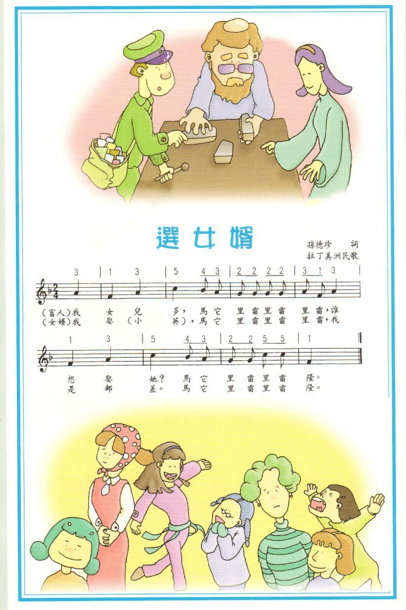
    複製編輯選女婿    孫德珍詞, 拉丁美洲民歌
    
    我女兒多,馬它里雷里雷里雷,  
    誰想娶她,馬它里雷里雷隆。  
    我娶小英(新娘名),馬它里雷里雷里雷,  
    我是郵差(女婿職業),馬它里雷里雷隆。
    

    English (singable)

    css複製編輯Choosing a groom, folk song from Latin America  
    (by Der-Jen Sun, lyrics)
    
    I have daughters, ma-ta-li-re-li-re-li-re,  
    Who will marry them? ma-ta-li-re-li-re-long.  
    I marry Ying (bride’s name), ma-ta-li-re-li-re-li-re,  
    I am a postman (groom’s job), ma-ta-li-re-li-re-long.
    

    單元目標 Unit Goal

    合不合
    Harmony / Matching


    教具 Teaching Aids

    音磚 F A C’
    Pitch blocks: F A C’


    • 背景說明 Background for Teachers and Parents

    中文

    高低不同的音同時出現成為和聲。
    歌曲中的獨唱部分為 F 大三和弦的分解和弦,幫助幼兒記憶及辨認大三和弦。

    English

    Different pitches played simultaneously form harmony.
    The solo part of the song uses the broken F major triad (F–A–C) to help children memorize and identify the major triad.


    • 故事 Story

    中文

    從前有一個富人,他有七個女兒,女兒們都長大了,他想要為這些女兒們找女婿。於是,他就貼了廣告:「誰最最有用的人,誰就可以娶一個女兒當老婆。」

    這一天,選女婿的日子到了,好多年輕人來排隊,富人把女兒們一一叫出來,問道:
    「誰要娶 ××?」

    這時候,一位年輕人走上前喊道:
    「我要娶某某,我是一個……。」

    大女兒說:「那要來考考他啊。」她拿了三片音磚:F、A、C,請郵差把眼睛閉好。大女兒說:
    「這裡有三個音,你聽 F A C。現在我敲了其中的一個音,請你找出來。」

    郵差聽完後答對了,富人問女兒:「合不合?」女兒說:「合。」於是郵差娶了小英。
    就這樣,富人一個一個試,直到所有女兒都嫁出去為止。


    English

    Once upon a time, there was a rich man who had seven daughters. When they all grew up, he decided to find husbands for them. So he posted a notice:
    “Whoever is the most useful person can marry one of my daughters.”

    On the day of choosing a son-in-law, many young men lined up. The rich man called out each daughter in turn and asked:
    “Who wants to marry ___?”

    A young man stepped forward and said:
    “I want to marry her. I am a ___.”

    The eldest daughter replied, “Let’s test him.” She took three pitch blocks — F, A, and C — and asked the postman to close his eyes. She said:
    “Here are three notes: F, A, and C. Now I will strike one of them; tell me which one it is.”

    The postman answered correctly. The rich man asked his daughter, “Do they match?” She replied, “Yes, they do.” So the postman married Ying.
    In this way, the rich man tested each suitor until all his daughters were married.


    • 互動過程 Interactive Activities

    中文

    1. 說故事:《選女婿》。
    2. 唱歌:《選女婿》全班合唱,引導者請三位幼兒各持 FAC’ 音磚為獨唱部分伴奏。
    3. 遊戲:《選女婿》
      • 幼兒圍成一圈,引導者帶著七位幼兒在圈內排成一排。
      • 一邊唱一邊走,歌曲停止時,走到一位「男士」面前,那位「男士」要接唱「我要娶 ××」、「我是 ××」。
      • 每次唱到「馬它里雷里雷隆」時,全體一起唱,男士指定新娘後閉上眼睛,新娘在音磚上敲一個音考男士,男士要在音磚中找出那個音,只許找一次。
      • 引導者問全班:「合不合?」如果合就可以娶她,男士把新娘抱到圈外,得一分;如果敲錯了,男士就要到圈內換下一位繼續,以此類推,直到所有新娘結束。

    English

    1. Story: Tell the story “Choosing a Son-in-Law.”
    2. Song: Sing the song together. Invite three children to hold pitch blocks (F–A–C) to accompany the solo part.
    3. Game: “Choosing a Son-in-Law”
      • Children form a circle, and seven children stand inside in a line.
      • While singing, walk around the circle. When the song stops, one “gentleman” steps in front of a “lady” and sings, “I want to marry ___; I am a ___.”
      • Each time the refrain “ma-ta-li-re-li-re-long” appears, the class sings together. The gentleman points to a bride, closes his eyes, and listens as she strikes one pitch block. He must identify the note correctly on the first try.
      • Facilitator asks, “Do they match?” If correct, the gentleman marries the bride and takes her outside the circle (earns one point). If incorrect, he stays inside, and the next player continues. Repeat until all brides are married.
    • Beauty of Sharing: The Grandfather Clock
    • 歌詞 Lyrics
      中文
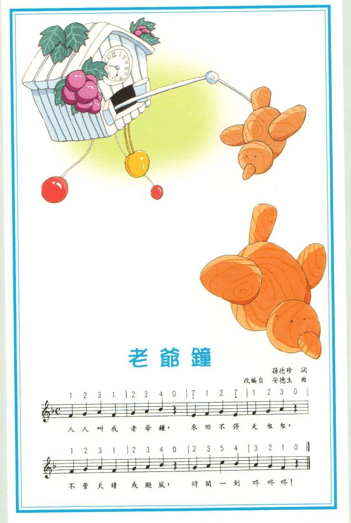
      人人叫我老爺鐘 來回不停走匆匆 不管天氣或颳風 時間一到咚咚咚
    • English (singable version)
      Everyone calls me Grandpa Clock, Tick and tock, I never stop. Rain or shine, I mark the time, Chiming loud with every chime!

      單元目標 Unit Goal

      Beat

      教具 Teaching Aids
      節奏樂器
      Percussion instruments

      背景說明 Background for Teachers and Parents
      中文
      規律拍是節奏的基礎,本單元藉著鐘聲的來回擺動,讓幼兒從身體的律動感受規律拍。
      並藉著欣賞音樂伴奏的不同,立刻對曲式做反應:不一樣的段落,做不一樣的動作。

      English
      Regular beat is the foundation of rhythm.
      In this unit, children experience the regular beat through the swinging motion of a clock.
      They also practice responding to changes in musical sections by performing different movements for contrasting passages.

      互動過程 Interactive Activities
      一、唱謠 Chant
      中文
      人人叫我老爺鐘
      來回不停走匆匆
      不管天氣或颳風
      時間一到咚咚咚
      English
      Everyone calls me Grandpa Clock,
      Tick and tock, I never stop.
      Rain or shine, I mark the time,
      Chiming loud with every chime!

      二、歌曲教學 Song Learning
      教幼兒學唱《老爺鐘》歌曲,並配合節拍走路或擺動手臂。

      三、律動化音樂欣賞 Move into Music
      引導者介紹老爺鐘的故事:
      老爺鐘有個長長的鐘擺,不斷地來回走著。
      走啊走啊,分針就轉一圈了,一個小時過去了。
      時針轉了一圈,太陽出來又下山了。
      Facilitator introduces the story of the Grandfather Clock:
      The grandfather clock has a long pendulum that keeps swinging back and forth.
      As it swings, the minute hand makes one full circle—an hour has passed.
      When the hour hand turns, the sun rises and then sets.

      聽聽音樂中有鐘擺的聲音,跟著音樂做鐘擺來回動的律動。當音樂進入新段落,沒有鐘擺聲音,變成時針和分針轉動,聽音樂變換轉動和擺動。
      Listen to the music for the sound of the swinging pendulum and move along with it. When the music enters a new section without the pendulum sound, switch movements to imitate the turning of the hour and minute hands, responding to the music’s changes.

  • Beauty of Sharing: The Secret-Keeping Balloon


    • 歌詞 Lyrics

    中文

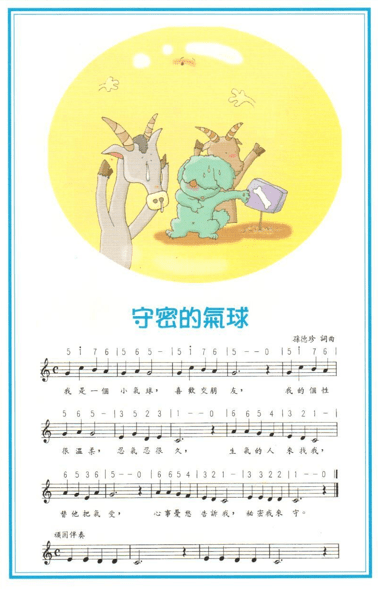
    複製編輯我是一個小氣球  
    喜歡交朋友  
    我的個性很溫柔  
    忍氣忍很久  
    生氣的人來找我  
    替他把氣受  
    心事憂愁告訴我  
    秘密我來守
    

    English (singable version)

    css複製編輯I am just a little balloon,  
    Loving friends beneath the moon.  
    Soft and gentle, calm I stay,  
    Holding anger far away.  
    Come to me when you’re upset,  
    Tell me things you can’t forget.  
    Whispers kept within my heart,  
    Secrets safe in every part.
    

    • 單元目標 Unit Goal

    音高
    Pitch


    • 教具 Teaching Aids

    音磚 E
    Tone bar E


    • 背景說明 Background for Teachers and Parents

    中文

    本單元藉著故事《守密的氣球》讓幼兒體驗到音高保持(守密)與音長保持(忍氣)在音樂中的重要。
    生活中不該說的話不要亂說(守密);該做的事要忍耐做完(忍耐盡責)。


    English

    This unit uses the story The Secret-Keeping Balloon to help children experience the importance of holding pitch (keeping secrets) and holding note length (enduring patience) in music.
    In life, children also learn: Do not speak out secrets (keep them), and endure to finish tasks responsibly (patience and diligence).


    • 故事 Story

    中文

    從前有一個小氣球,他很喜歡交朋友。
    小氣球的個性很溫柔,如果有人生氣了去找他,把氣吹到他的肚子裡去,他就把肚子脹起來替人受氣。
    如果有人要他保守秘密,他就會一直忍著、忍著,忍到人把他鬆開為止。

    有一天,馬跑去找他,因為牛借了他的角都不還。
    氣球說:「你有什麼心事告訴我。」
    馬說:「牛小弟為了參加選美,向我借了角卻不還。」
    氣球說:「那你一定很生氣吧!讓我替你把怒氣收起來好了。」
    馬說:「謝謝你,但是我現在沒有角,如果人家知道了一定會笑我的。」
    氣球說:「我不會告訴別人的。」

    過了幾天,來了一隻哈巴狗。
    哈巴狗說:「我在院子裡埋了幾根老骨頭,請你不要告訴別人。」

    有一天,馬和哈巴狗想去看氣球,
    他們發現氣球變得好大、好長。

    原來忍氣可以使人長大,
    替人保守秘密實在是偉大。


    English

    Once upon a time, there was a little balloon who loved making friends.
    The balloon was gentle in nature. Whenever someone felt angry, they would blow their anger into the balloon’s belly, and the balloon would hold it inside, keeping the person calm.
    If someone needed the balloon to keep a secret, it would quietly hold it, patiently waiting until the person was ready to let it go.

    One day, a horse came to the balloon, upset because a cow had borrowed his horns and never returned them.
    The balloon asked, “Do you have something on your mind? Tell me.”
    The horse said, “Little Cow borrowed my horns to join a beauty contest and hasn’t given them back.”
    The balloon replied, “You must be really angry! Let me hold your anger for you.”
    “Thank you,” said the horse, “but now I have no horns. If others find out, they’ll laugh at me.”
    “Don’t worry,” said the balloon, “I won’t tell anyone.”

    A few days later, a pug came by and whispered,
    “I buried some old bones in the yard. Please don’t tell anyone.”

    Later, the horse and the pug came to visit the balloon and were surprised:
    The balloon had grown so big and tall!

    They realized—holding in anger helps one grow;
    keeping secrets for others is truly noble.


    • 互動過程 Interactive Activities

    一、音感 Tone Awareness

    • 說故事:聽老師講《守密的氣球》的故事。

    二、遊戲:保守秘密 Secret-Keeping Game

    1. 引導者告訴幼兒:讓幼兒當守密的氣球,替音磚保守秘密。音磚不會吹氣,但會出聲音;幼兒聽完音磚的秘密要把音高繼續保留著。
    2. 引導者敲音磚起音,讓幼兒跟著唱(秘密 Mi Mi)。
    3. 邀請幼兒多做幾次練習,指導者以手勢控制音長,教幼兒把音長唱滿。

    三、演唱 Singing

    • 練習唱《守密的氣球》歌曲,並結合遊戲經驗,體驗「守密與忍氣」的音樂表達。
  • Beauty of Sharing: Blowing Bubbles


    • 歌詞 Lyrics

    中文

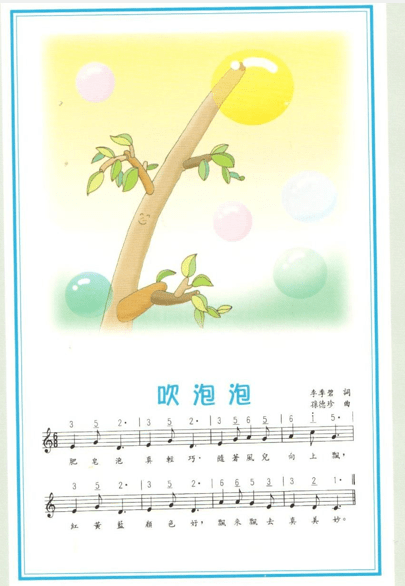
    複製編輯肥皂泡真輕巧  
    隨著風兒向上飄  
    紅黃藍顏色好  
    飄來飄去真奇妙
    

    English (singable version)

    pgsql複製編輯Little bubbles, light and small,  
    Float up gently, over all.  
    Red and yellow, blue so bright,  
    Drifting here and there in light.
    

    • 單元目標 Unit Goal

    和聲
    Harmony


    • 背景說明 Background for Teachers and Parents

    中文

    黃色加上紅色會調成暖暖的橙色,黃色加上藍色會調成涼涼的綠色;
    在兩個五度音中加上大三度就會形成大三和弦
    加上小三度就會形成小三和弦


    English

    Mixing yellow with red creates a warm orange color, and mixing yellow with blue creates a cool green color.
    In music, adding a major third between two perfect fifths forms a major triad, while adding a minor third forms a minor triad.


    • 資料庫・律動 Story & Movement

    中文

    聽音樂作肥皂泡飄去看太陽(大調伴奏),或掉到小草裡(小調伴奏)。

    English

    Listen to the music: bubbles float up to see the sun (major mode), or drop into the grass (minor mode).


    • 互動過程 Interactive Activities

    一、遊戲 Game

    (一) 吹泡泡 Blowing Bubbles

    1. 引導者以事先調好的肥皂水來吹泡泡,讓幼兒觀察是否能發現泡泡上的彩虹。
    2. 問幼兒彩虹上有什麼顏色?告訴幼兒這些顏色其實是三個顏色變出來的(三原色)。

    (二) 調色 Color Mixing

    1. 引導者和幼兒一起看實物圖片分顏色:認識彩虹上的七種顏色(例如:太陽是橙色,小草是綠色)。
    2. 引導者帶幼兒在圖片中找到紅、黃、藍三原色。
    3. 取出水彩,將黃色加紅色調在一起,請幼兒觀察變成什麼顏色?(橙色)
    4. 取出水彩,將黃色加藍色調在一起,請幼兒觀察變成什麼顏色?(綠色)

    二、歌曲・吹泡泡 Song: Blowing Bubbles

    1. 教幼兒唱《吹泡泡》這首歌,注意是慢的複拍子
    2. 把自己變成肥皂泡,一面唱一面做律動。
    3. 告訴幼兒有的肥皂泡飄到天上看太陽(大調)。
    4. 告訴幼兒有的肥皂泡掉到小草裡(小調)。
    5. 跟著音樂的表情做肥皂泡飄上天空看太陽、肥皂泡掉到小草裡的動作。
    • Beauty of Sharing: Big Fish Won’t Come, Little Fish Will

    • 歌詞 Lyrics

    中文

    複製編輯大魚不來,小魚來;  
    小魚不來,蝦蟹來。  
    蝦蟹來了,小魚來;  
    小魚來了,大魚來。
    

    English (singable version)

    nginx複製編輯Big fish won’t come, little fish will,  
    Little fish won’t come, crabs and shrimp will.  
    Crabs and shrimp come, little fish will,  
    Little fish come, big fish will!
    

    • 單元目標 Unit Goal

    音高
    Pitch


    • 教具 Teaching Aids

    音磚 C・E・G
    Tone bars C・E・G


    • 背景說明 Background for Teachers and Parents

    中文

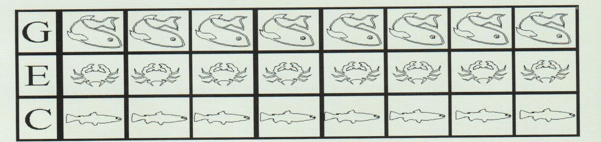
    1. 本單元藉著釣魚遊戲,讓幼兒練習三音旋律(C、E、G)視奏。
    2. 幼兒在創作過程中:
      (1) 選魚、(2) 圈選(畫音符)、(3) 演奏(視奏),
      這些都是將來正式創作的準備經驗。

    English

    1. This unit uses a fishing game to help children practice sight-playing three-note melodies (C, E, G).
    2. In the creative process, children will:
      (1) choose the fish, (2) circle or draw the notes, and (3) perform them (sight-play).
      These steps serve as preparatory experiences for future formal composition.

    • 互動過程 Interactive Activities

    一、兒歌導入 Rhyme Introduction

    • 教師與幼兒一起背誦並拍手念兒歌,提示順序與角色。

    二、九宮格遊戲:釣魚 9-Grid Fishing Game

    1. 在黑板上畫九宮格,內標示 大魚(G)小魚(C)蝦蟹(E)
    2. 幼兒分組,每組代表一種角色,對應音高 C E G
    3. 引導者依序指揮,每次在縱列中唱出一音,幼兒聽音找到相應角色並舉牌或動作表示。

    三、歌曲教學 Song Learning

    1. 教唱單元歌曲《大魚不來小魚來》。
    2. 幼兒邊唱邊配合角色進入遊戲情境:大魚、小魚、蝦蟹輪流出現。

    四、律動化音樂欣賞:聖桑《動物狂歡節》水族館

    Move into Music: Camille Saint-Saëns “The Carnival of the Animals – Aquarium”

    中文
    觀察魚在水族箱中游動的樣子:

    • 有時游得快,有時游得慢;
    • 有時休息一會兒;
    • 有沒有聽到音樂表現出魚飼料下沉的聲音

    English
    Observe how the fish move in the aquarium:

    • Sometimes swimming fast, sometimes slow;
    • Sometimes resting for a moment;
    • Can you hear how the music shows the sound of fish food sinking?

    五、三音旋律創作 Three-Note Composition

    • 圈選大魚(G)、小魚(C)、蝦蟹(E)三角色,創作屬於自己的釣魚旋律。
    • 將創作貼在音磚上或用樂器演奏,與同伴分享。
  • Beauty of Sharing: Water


    • 歌詞 Lyrics

    中文

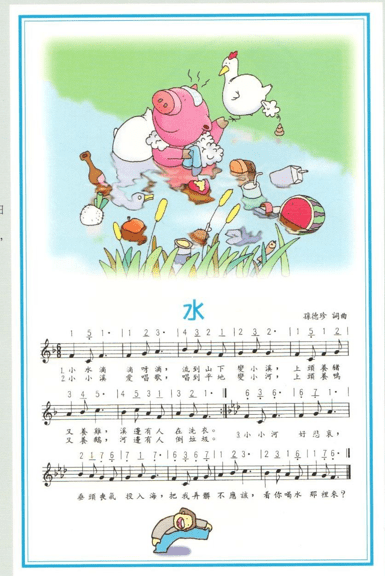
    複製編輯小水滴,滴呀滴,流到山下變小溪。  
    上頭養豬又養雞,溪邊有人在洗衣。  
    
    小小溪,愛唱歌,唱到平地變小河。  
    上頭養鴨又養鵝,河邊有人倒垃圾。  
    
    小小河,好悲哀,垂頭喪氣投入海。  
    把我弄髒不應該,看你喝水哪裡來?
    

    English (singable version)

    pgsql複製編輯Little raindrops, drip-drop fall,  
    Down the mountain, streams grow tall.  
    Up above, pigs and chickens stay,  
    By the stream, they wash all day.
    
    Little stream, it loves to sing,  
    Reaches flatlands, turns to spring.  
    Up above, ducks and geese reside,  
    By the river, trash is thrown inside.
    
    Little river, sad and grey,  
    Hangs its head and drifts away.  
    Pollute the water — is it right?  
    Where will your clean water flow tonight?
    

    • 單元目標 Unit Goal

    和聲
    Harmony


    • 教具 Teaching Aids

    節奏樂器 Rhythm instruments


    • 背景說明 Background for Teachers and Parents

    中文

    本單元透過三段故事與歌曲,介紹水從小水滴變成溪流、河流再到海洋的過程,並引導幼兒察覺音樂中三度音變化所帶出的情感轉換(大調歡快、小調悲傷)。活動同時帶出環境教育,讓幼兒思考乾淨水源的重要性污染帶來的影響

    English

    This unit uses three-part storytelling and song to illustrate how water flows from raindrops to streams, rivers, and finally to the ocean. It introduces the concept of third intervals in music and how changes between major and minor modes express different emotions (joy vs. sadness). The activities also include environmental education, guiding children to reflect on the importance of clean water and the effects of pollution.


    • 資料庫故事 Story

    中文

    天空裡住著一滴小雨滴。
    有一天,它遇見了其他的小雨滴,它們都想一起下地上玩,於是它們結成大大的水滴,落在山上。
    小雨滴遇到了新朋友,它們變成小溪。
    小溪快樂地往前跑,一路上看到了人養雞,又有人洗衣。
    小溪唱歌,可它並沒有生氣,還是快樂地唱著歌往前跑。

    不久,遇到了更多朋友,它們又結成更大的隊伍,成為小河。
    小河唱著歌,一邊唱一邊走,看到了人養了好多豬和鵝。
    人們把豬和鵝的大便都倒到河裡,小河氣得臉都紅了。
    然後,小河又看見有人把垃圾往河裡倒,連吐也來不及!

    小河忍不住哭了起來。
    人們還是照樣把髒東西倒進河裡,小河生病了。
    它病得越來越重,越來越醜,越來越臭。
    最後,小河往海裡一跳,讓人們再也看不到它。


    English

    In the sky lived a tiny raindrop.
    One day, it met other little raindrops, and they all wanted to fall to the earth to play. They joined together into a big drop of water and fell onto the mountains.
    The raindrop met new friends and became a stream.
    The stream happily ran forward, seeing chickens and people washing clothes along the way.
    The little stream sang songs and kept flowing joyfully, without anger.

    Soon, it met even more friends, joining together to become a river.
    The river sang as it flowed, passing by where people raised pigs and geese.
    But people dumped animal waste into the river, making it turn red with anger.
    Then they threw garbage into the river, and it barely had time to breathe!

    The river began to cry.
    Yet people continued dumping trash, and the river grew sicker — dirtier, uglier, and smellier.
    Finally, the river leapt into the sea, disappearing from sight.


    • 互動過程 Interactive Activities

    一、故事導入 Storytelling

    • 老師講述《水》的故事,引導幼兒感受水的旅程與心情變化。

    二、歌曲學習 Song Learning: 水

    1. 第一段與第二段為大調(歡快)。
    2. 第三段轉為小調,與前兩段形成情感對比。
    3. 引導幼兒聽出三度音變化。

    三、律動創作 Movement with Music

    • 分三段音樂表演不同情緒的律動:
      1. 第一段:輕快跳躍(每小節兩次)
      2. 第二段:悠閒遊走(每小節兩次)
      3. 第三段:沉重不滿(每小節兩次)

    四、討論與延伸 Discussion

    1. 水可以為我們做什麼?
    2. 故事中的人犯了什麼錯?
    3. 如果沒有乾淨的水可以用,我們的生活會怎樣?
    • Interactive Activities

    1. Storytelling

    • The teacher narrates the story of Water, guiding children to feel the journey of water and its emotional changes.

    2. Song Learning: Water

    1. The first and second verses are in major mode (cheerful).
    2. The third verse shifts to minor mode, creating an emotional contrast with the first two.
    3. Guide children to notice the change in third intervals within the melody.

    3. Movement with Music

    • Perform different movements to express the emotions of each musical section:
      1. First verse: Light, playful jumps (twice per measure).
      2. Second verse: Gentle, leisurely walking (twice per measure).
      3. Third verse: Heavy, discontented movements (twice per measure).

    4. Discussion and Extension

    1. What can water do for us?
    2. What mistakes did the people in the story make?
    3. If we had no clean water, what would our life be like?
  • Beauty of Sharing: Falling Snowflakes


    • 歌詞 Lyrics

    中文

    複製編輯雪花飄,  
    飄下來,飄下來,  
    雪花飄下來。
    

    English (singable version)

    nginx複製編輯Snowflakes fall,  
    Falling down, falling down,  
    Snowflakes falling down.
    

    • 單元目標 Unit Goal

    下行
    Descending Motion


    • 教具 Teaching Aids

    鐵琴 Glockenspiel


    • 背景說明 Background for Teachers and Parents

    中文

    本單元利用律動與旋律的上下行對比(聖誕樹長高、雪花飄下來),幫助幼兒在動作中建立對旋律走向的感受。孩子透過音高上升與下降的肢體表現,能直觀體會音樂的方向感,進而培養樂感與身體協調。

    English

    This lesson uses the contrast of ascending and descending melodies (the Christmas tree grows tall, snowflakes fall down) to help children physically experience melodic direction. By expressing rising and falling pitches through movement, children naturally develop a sense of musical contour and coordination.


    • 資料庫故事 Story

    中文

    在地球的北方,住著一位老公公,
    他總是穿著一身紅衣紅帽,他的鬍子很白很長。
    每年聖誕節的時候,他就乘著雪橇,到有小朋友的地方,送給乖巧的小朋友聖誕禮物,
    所以大家稱他為「聖誕老人」。

    因為聖誕老人總是在聖誕夜出現,所以人們就在院子裡種上聖誕樹。
    等聖誕樹長大了,雪花開始飄下來時,
    大家就把聖誕樹砍下來,放到煙囪旁邊,
    並且在樹上掛上許多燈,讓聖誕老人看得到放禮物的襪子。


    English

    In the far north of the world, there lived an old man.
    He always wore a red coat and a red hat, with a long, white beard.
    Every Christmas, he rode his sleigh to where children lived, bringing gifts to the well-behaved ones.
    People called him Santa Claus.

    Because Santa always appeared on Christmas Eve, families would plant a Christmas tree in their yard.
    When the tree grew tall and snowflakes began to fall,
    they would cut it down and place it beside the chimney,
    hanging many lights on the tree so Santa could see the stockings prepared for gifts.


    互動過程 Interactive Activities

    一、說故事 Storytelling

    • 引導者講述「聖誕樹的故事」,幫助幼兒了解情境與角色。

    二、肢體創作遊戲 Creative Movement

    1. 幼兒蹲下扮演聖誕樹種子,從地面開始生長(音樂由低到高)。
    2. 幼兒隨音樂慢慢長高,雙手舉高至最高點。
    3. 當雪花飄下時,幼兒輕搖雙手做雪花下落的動作,身體逐漸往下。

    三、歌曲教學 Song Learning: 雪花飄

    • 讓幼兒先聽一遍旋律,引導幼兒邊唱邊做「雪花飄」的律動,反覆練習。

    四、尾奏 Movement Ending

    • 兩手輕輕搖擺,模仿雪花飄落,身體緩緩下降至坐姿或蹲姿,與音樂結尾同步。
    • Beauty of Sharing: Police Catch the Thief

    • 歌詞 Lyrics

    中文

    複製編輯小偷,小偷,溜到哪去了?  
    小偷,小偷,看我把你找。  
    一步一步,小心跟好,  
    不要出聲叫。  
    左邊看看,右邊瞧瞧,  
    我從後面抓到了!
    

    English (singable version)

    vbnet複製編輯Thief, oh thief, where did you run away?  
    Thief, oh thief, I’ll find you as I play.  
    Step by step now, quiet and slow,  
    Don’t make a sound, don’t let him know.  
    
    Look to the left, look to the right,  
    I’ll catch you from behind — hold tight!
    

    • 單元目標 Unit Goal

    模進
    Sequence (Imitation and Progression)


    • 教具 Teaching Aids

    節奏樂器 Rhythm instruments


    • 背景說明 Background for Teachers and Parents

    中文

    本單元利用「警察捉小偷」的故事,讓幼兒從探索角色以及警察的模仿動作中體驗音樂的模進,引導幼兒理解「一樣與不一樣」的音樂概念。藉由追逐遊戲,孩子能分辨哪些旋律或節奏相同,哪些不同,進而培養敏銳的聽覺與反應力。
    同時,本單元中「辨別足跡」的活動也能幫助孩子認字時,認出筆畫或偏旁的異同(相同與不同)。

    English

    This lesson uses the story of “Police Catch the Thief” to help children explore roles and imitate police movements while experiencing musical sequencing. It introduces the concept of “same and different” in melody and rhythm. Through the chase game, children develop sharper listening skills and quicker responses.
    Additionally, the “footprint recognition” activity prepares children for recognizing similarities and differences in Chinese character components when learning to read.


    • 資料庫故事 Story

    中文

    有一個小偷想要偷東西,有一個警察想要抓他。
    小偷爬上牆,警察跟著爬上牆;
    小偷從樹上溜下來,警察也從樹上溜下來;
    小偷小步走,警察也小步跟;
    小偷大步一跳,警察也大步一跳;
    小偷快快走,警察也快快走;
    小偷慢慢走,警察也慢慢跟。
    小偷轉頭一望,警察趕緊躲起來。
    小偷偷東西,把東西一樣一樣放進袋子,警察衝向前去,大喊一聲——從後面抱住小偷。

    English

    A thief wanted to steal something, and a police officer wanted to catch him.
    The thief climbed up the wall; the police climbed up the wall too.
    The thief slid down the tree; the police slid down the tree as well.
    The thief walked in tiny steps; the police followed in tiny steps.
    The thief jumped with big strides; the police jumped with big strides.
    The thief walked quickly; the police followed quickly.
    The thief walked slowly; the police followed slowly.
    The thief turned around; the police quickly hid.
    The thief stole some things, placing them one by one into a bag.
    The police charged forward, shouting loudly — and caught the thief from behind!


    • 互動過程 Interactive Activities

    一、故事與聲音 Story and Sound

    • 老師說一遍故事,引導幼兒聽故事並複述,注意情節順序。

    二、用聲音說故事 Storytelling with Sound

    1. 討論故事順序。
    2. 討論各段的音色(樂器)及音樂。
    3. 決定角色與樂器分配。
    4. 演出:
      • 找兩位幼兒當小偷和警察,分別用木琴和鐵琴代表角色。
      • 小偷爬上牆時用什麼音樂?(上行音階)警察模仿。
      • 小偷從樹上溜下來時用什麼音樂?(下行音階)警察模仿。
      • 小偷小步走時用什麼節奏?(旋律疊進)警察模仿。
      • 小偷大步一跳時用什麼節奏?(五度跳進)警察模仿。
      • 小偷快快走、慢慢走,警察分別模仿速度改變。
      • 小偷轉頭一望時,用音樂表達警察的躲藏。
      • 小偷放東西進袋子時,用樂器一次一次表現,最後警察大聲抓住!

    三、歌曲 Song: 警察捉小偷

    • 教師用帶領與模仿的方式幫助幼兒唱出歌曲,並注意歌詞中的表情與節奏。

    四、律動活動 Movement Extension

    • 配合歌曲動作,讓孩子扮演警察與小偷追逐,體驗模進的音樂與身體表現。
  • Beauty of Sharing: Sending Oil Rice

    歌詞 Lyrics

    中文

    複製編輯一呀一,媽媽生弟弟  
    二呀二,爸爸笑呵呵  
    三呀三,滿月送油飯  
    四呀四,又香又好吃  
    
    五呀五,一盤給叔叔  
    六呀六,一盤給舅舅  
    七呀七,大家真客氣  
    八呀八,回賀小娃娃  
    
    九呀九,一盤白米加石頭  
    十呀十,將來甜蜜又結實
    

    English (singable version)

    pgsql複製編輯One by one, a baby boy is born,  
    Two by two, Dad’s laughing full of joy.  
    Three by three, oil rice to share with friends,  
    Four by four, it smells so good, no end!  
    
    Five by five, a plate for Uncle dear,  
    Six by six, for Mother’s brother here.  
    Seven by seven, thanks to all we meet,  
    Eight by eight, they bless the newborn sweet.  
    
    Nine by nine, return with rice and stone,  
    Ten by ten, may life be sweet and strong at home.
    

    單元目標 Unit Goal

    回應
    Response


    教具 Teaching Aids

    節奏樂器 Rhythm instruments


    背景說明 Background for Teachers and Parents

    中文

    1. 押韻使得兒歌好唸好聽,藉著數字和句尾的押韻,可以預備幼兒對和聲的概念。
    2. 藉著送油飯的民俗,讓幼兒認識「禮尚往來」——分享喜悅,也學會以回應表達感謝。

    English

    1. Rhyme makes nursery songs easy to recite and pleasant to hear. Using numbers and rhyming endings helps prepare children to sense harmony.
    2. Through the tradition of sending oil rice, children learn about reciprocal giving—sharing joy and responding with gratitude.

    民俗介紹 Cultural Story

    中文

    送油飯是台灣民間的一種禮俗:
    通常某家添了兒子(尤其是第一胎),就在滿月那天,煮很多油飯分送給鄰居和親友,讓大家一起分享。收到油飯的家庭要將油飯收下,將空盤子裝一盤白米、白米上壓一塊小石頭,送還人家,並且說幾句祝福的話。

    English

    Sending oil rice is a traditional Taiwanese custom:
    When a family welcomes a baby boy (especially the firstborn), they cook large batches of oil rice on the baby’s full moon day and share them with neighbors and relatives. Those who receive the rice return the empty plate filled with white rice and topped with a small stone—symbolizing blessings of strength and prosperity—and say words of congratulations.


    互動過程 Interactive Activities

    一、唱兒歌 Sing the Nursery Song

    • 教師先介紹送油飯的民俗,再帶幼兒唱一遍兒歌。

    二、數字與押韻練習 Number and Rhyme Practice

    • 引導幼兒注意歌詞中數字的順序與句尾的押韻,跟著拍手或敲樂器。

    三、角色扮演 Role-Play

    • 模擬「送油飯」的情境:一組幼兒送油飯,另一組幼兒回送白米與祝福,學習互動禮貌。

    四、延伸討論 Extension

    • 問孩子:你家有什麼分享喜事的習慣?
    • 引導孩子說出祝福語,體驗「給與回應」的美好。

    中文

    複製編輯我想找個好朋友  
    我想找個好朋友  
    如果你肯和我做朋友  
    請你跟我這樣走
    

    English (singable version)

    vbnet複製編輯I want to find a friend to play,  
    I want to find a friend today.  
    If you will be my friend so true,  
    Come and do what I will do.
    

    • 單元目標 Unit Goal

    長短
    Rhythm: Long and Short


    • 教具 Teaching Aids

    節奏樂器 Rhythm instruments


    • 背景說明 Background for Teachers and Parents

    中文

    3-8歲的幼兒正值一生中聽力發展之黃金時期,此時從生活中所獲取音樂的經驗,對概念的建立有莫大的助益,對其聽力及個性的發展也有極深遠的影響。

    在《如鷹展翅》中,我們談到打開閱讀的解碼系統,而「用聲音說故事」也是其中的一環。此方法從說故事開始,接著引導孩子回想故事順序,並因為要演出而進一步思考音樂如何配合。這與「律動化音樂欣賞」相呼應,都是本教材的重要特色:透過聲音與律動,讓孩子在敘事、音樂與語言之間建立全方位的理解與表達。

    English

    Children aged 3–8 are in the golden stage of auditory development. Musical experiences drawn from daily life during this period greatly support concept formation and have a profound impact on both their listening abilities and personality development.

    In As the Eagle Soars, we emphasize unlocking the decoding system for reading. “Telling stories with sound” is an essential part of this process. It begins with listening to a story, then guides children to recall the sequence of events, and finally encourages them to design sound and music for performance. This approach parallels our rhythmic music appreciation activities—both are key features of the curriculum, integrating storytelling, music, and movement for a holistic learning experience.


    • 資料庫故事 Story

    中文

    有個人想找朋友玩,他匆匆走進電話亭,推開門,拿起話筒,投入硬幣撥號按按鈕。
    對方的線路一直都通話中(老師模仿嘟嘟嘟的聲音),這個人把電話掛掉後再重新試了一個號碼,電話響了很久卻沒有人接(老師模仿鈴鈴鈴的聲音),他掛上電話,拿出銅板,很失望地嘆了一口氣走出電話亭。

    English

    A person wanted to find a friend to play with. He rushed into a phone booth, opened the door, picked up the receiver, inserted a coin, and dialed the number.
    The line was busy (teacher imitates “beep, beep, beep”), so he hung up and tried another number. This time the phone rang for a long time, but no one answered (teacher imitates “ring, ring, ring”). He hung up, took out the coin, sighed in disappointment, and walked out of the booth.


    • 互動過程 Interactive Activities

    一、說故事 Storytelling

    • 老師先說一遍故事,要求幼兒專心聆聽。

    二、整理故事順序 Sequencing

    • 請幼兒回顧故事情節,討論並整理事件的先後順序。

    三、用聲音說故事 Storytelling with Sound

    • 為故事的每一段配上合適的聲音與動作,嘗試用不同樂器找出最佳效果。

    四、排練 Rehearsal

    • 分段練習聲音與動作的配合,逐步串聯成完整故事。

    五、演出 Performance

    • 幼兒在老師指導下完成「用聲音說故事」的表演,體驗聲音與敘事的結合。

    六、歌曲 Song: 找朋友

    • 帶領幼兒唱《找朋友》歌曲,將聲音活動與歌唱自然銜接。