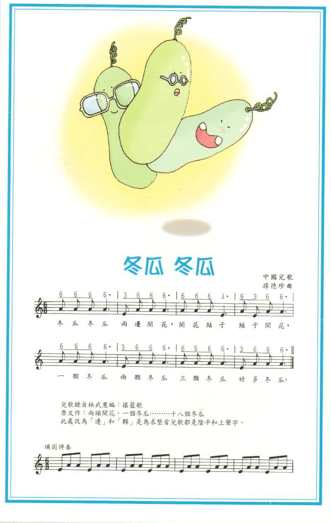
• 中國兒歌 孫德珍曲 | Chinese Children’s Song, Music by Sun Der-Jen


    歌詞 Lyrics

    複製編輯冬瓜冬瓜,兩邊開花,  
    開花結子,結子開花。  
    一顆冬瓜,兩顆冬瓜,  
    三顆冬瓜,好多冬瓜。
    

    English (singable version):

    pgsql複製編輯Winter melons bloom, flowers on each side,  
    Flowers turn to fruit, fruit and flowers ride.  
    One melon, two melons, three on the vine,  
    So many melons, growing in a line.
    

    單元目標 Unit Goal

    高低
    Pitch: High and Low


    教具 Teaching Aids

    音磚 E A


    背景說明 Background for Teachers and Parents

    中文
    音調是音樂的要素之一,也是中文語音的特質。國內四聲中陰平(第一聲)的字和上聲(第三聲)的字組合成為四度音程,本課就是利用這種四度音程的高低關係,讓幼兒從中文語音中感覺音調。

    English
    Pitch is one of the core elements of music and is also a feature of Mandarin Chinese. In Mandarin’s four tones, the combination of first tone (high level) and third tone (low rising) creates an interval of a fourth. This lesson uses that natural high–low relationship in speech to help children experience pitch through familiar language.


    資料庫故事 Story

    牛和馬 The Bull and the Horse

    中文
    從前牛和馬是一對好朋友,那時候牛的頭上並沒有角。有一天,牛小弟想去參加選美比賽,牠看到了馬大哥的頭上有一對美麗的角,非常羨慕,便對馬說:
    「馬大哥,我想去參加選美會,不知道你願不願意把你頭上的角借我一下?」

    馬聽了對牛說:「牛小弟,我們是好朋友,當然可以。」於是馬將角折下來借給牛,並且叮嚀說要比賽完立刻還給自己。結果牛參加了比賽並獲得了第二名。

    牛自從在選美會得到了第二名以後,覺得非常驕傲而且自私,牠不但不肯把角還給馬,而且對馬也不理不睬。

    可憐的馬好不容易找到牛,就對牛說:「還!」(把手舉高,用尖銳的聲音)
    但是牛很賴皮地把頭低下來說:「沒。」
    你猜牠還不還呢?


    English
    Once upon a time, the bull and the horse were best friends. Back then, the bull had no horns. One day, the bull wanted to enter a beauty contest. He saw the horse’s beautiful horns and said:
    “Brother Horse, I want to join the contest. Would you lend me your horns?”

    The horse replied, “Brother Bull, we’re good friends—of course I can.” So the horse removed his horns and lent them to the bull, reminding him to return them right after the contest. The bull entered the contest and won second place.

    After the contest, the bull became proud and selfish. He refused to return the horns and even ignored the horse.

    The poor horse finally found the bull and shouted, “Return!” (Raise your hand and use a sharp voice.)
    But the bull lowered his head and replied, “No.”
    Do you think he will give them back?


    互動過程 Interactive Activities

    1. 故事導入 Storytelling

    • 透過「牛和馬」的故事,引導孩子注意聲音的高低表現(馬:高音;牛:低音)。

    2. 九宮格聲音遊戲 Nine-Square Pitch Game: Cow and Horse

    中文

    • 引導者在黑板上畫一個九宮格,在其中隨意填上往上或往下的箭頭代表馬和牛。
    • 每指到其中一格,讓幼兒模仿馬和牛的聲音與動作:
      • 馬 → 抬頭,高音「還!」
      • 牛 → 低頭,低音「沒!」

    English

    • Draw a nine-square grid on the board and randomly fill it with upward or downward arrows representing the horse and the cow.
    • As you point to each square, children imitate the animal’s movement and pitch:
      • Horse → lift head, high-pitched “Return!”
      • Cow → lower head, low-pitched “No!”

    3. 歌曲教學 Song Learning: 冬瓜冬瓜

    中文

    1. 先帶幼兒唱一遍兒歌。
    2. 告訴幼兒歌曲中出現「唸音兒歌」,讓幼兒先聽一遍。
    3. 引導幼兒跟著音符唸音兒歌;引導者不可示範唱,由於本課歌詞的語調關係,幼兒會自然轉成音高的說法。
    4. 鼓勵幼兒從生活的音符中找到本單元歌曲的旋律。

    English

    1. Sing the nursery song with the children once.
    2. Point out that the song includes spoken melody phrases and let them listen first.
    3. Guide children to speak the rhythm with pitch patterns (without teacher singing)—they will naturally transform it into melody through the tonal speech.
    4. Encourage children to discover the melody of this song from sounds around them.

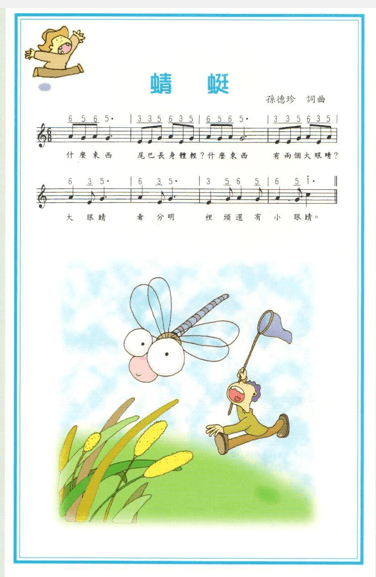
    孫德珍 詞曲 | Lyrics & Music by Sun Der-Jen


    歌詞 Lyrics

    複製編輯什麼東西 尾巴長身體輕  
    什麼東西 有兩個大眼睛  
    大眼睛看分明  
    裡頭還有小眼睛
    

    English (literal meaning):

    vbnet複製編輯What is it? Tail long and body light.  
    What is it? With two big eyes so bright.  
    Big eyes see things clear and keen,  
    Inside, there are tiny eyes unseen.
    

    單元目標 Unit Goal

    板眼(重拍與弱拍)
    Beats and Sub-beats (Strong Pulse and Weak Pulse)


    教具 Teaching Aids

    節奏樂器(響板、拍手、打擊樂器)
    Rhythm instruments (clappers, hand claps, percussion)


    背景說明 Background for Teachers and Parents

    中文
    國劇中有一板一眼的節奏;板代表重音,眼代表弱音。本單元藉蜻蜓的複眼來介紹音樂中的拍子:規律拍中重拍和輕拍分配的週期。國劇中有一板一眼和一板三眼,本單元中的一板二眼在中國國劇中並不存在,只是作者引伸以介紹複拍子。

    English
    In traditional Chinese opera, rhythm is described as “one beat, one eye”: the beat (板) marks the strong accent, while the eye (眼) marks the weaker accent. This lesson uses the compound eyes of a dragonfly to introduce musical meter—the cycle of strong and weak beats. While Chinese opera traditionally uses “one beat one eye” and “one beat three eyes,” this lesson introduces “one beat two eyes” as a creative way to explore compound meter.


    活動引導語 Instruction to Children

    中文
    老師告訴幼兒:形容一個人唱歌拍子抓得準,我們說他唱得有板有眼;一個人做事該怎樣就怎樣,我們也稱讚他做事有板有眼。

    English
    Tell the children: When someone sings with precise rhythm, we say they sing “with beat and eye”. When someone does things properly and in order, we also praise them as “having beat and eye.”


    • 互動遊戲 Interactive Game: 老師當蜻蜓的大眼睛 Teacher as the Dragonfly’s Big Eye

    (1) 一板一眼 One Beat, One Eye

    • 中文
      一個大眼睛裡面有一個小眼睛。老師拿響板拍一下後(大眼睛—重拍),幼兒以右手拇指、食指圈成眼睛形狀在左手手心上敲一下(小眼睛—弱拍)。一邊拍、一邊唱口訣「板、眼」,保持拍的進行。
    • English
      One big eye contains one small eye. The teacher claps the clapper once (big eye—strong beat). Children form a circle with thumb and index finger of the right hand and tap the left palm (small eye—weak beat), chanting “beat, eye” while keeping the rhythm steady.

    (2) 一板二眼 One Beat, Two Eyes

    • 中文
      一個大眼睛裡面有兩個小眼睛。老師拿響板拍一下後(大眼睛—重拍),幼兒以右手拇指、食指圈成眼睛形狀在左手手心上敲兩下(小眼睛—弱拍)。一邊拍、一邊唱口訣「板、眼、眼」,保持拍的進行。
    • English
      One big eye contains two small eyes. The teacher claps the clapper once (big eye—strong beat). Children tap twice on the left palm (small eyes—weak beats), chanting “beat, eye, eye” to keep the rhythm.

    (3) 板眼卡片練習 Card Practice for Beat and Eye

    • 中文
      老師揭示兩張板眼卡,分別代表「一板一眼」與「一板二眼」,讓幼兒猜該如何拍。
    • English
      The teacher shows two rhythm cards: “one beat one eye” and “one beat two eyes.” Children guess and demonstrate the corresponding clapping pattern.

    律動化音樂欣賞 Rhythmic Music Appreciation

    聖桑《動物狂歡節》— 大象
    Saint-Saëns Carnival of the Animals — The Elephant

    中文

    1. 跟著音樂裡的大象腳步,注意大象的腳很重,走得笨重。(踩在重音上)
    2. 大象出遊:
      • 看見朋友握握手
      • 看到河流,大象下去洗澡、互相噴水、水花閃亮
    3. 結隊回家,踩在重拍上。

    English

    1. Follow the elephant’s footsteps in the music. Notice how its heavy feet move clumsily—step on the strong beats.
    2. Elephant’s outing:
      • Shake hands with friends they meet
      • Jump into the river, splash water, and see sparkling drops
    3. March home in a line, stepping on each strong beat.

    合奏活動 Ensemble Activity

    中文
    會唱本單元歌曲後,老師發給幼兒節奏樂器,先由老師當板(大眼睛),幼兒當眼(小眼睛)。再由幼兒選一人當板,其他人當眼,一起合奏。也可以讓幼兒只敲板的節奏。

    English
    After learning the song, give each child a rhythm instrument. The teacher first plays the beat (big eye), while children play the eyes (small beats). Then, let a child take the role of beat, while others play the eyes, creating an ensemble together. Children can also try playing only the beat part for variation.


    • 1. 單元目標 Unit Objectives

    中文
    單元目標:音階

    English
    Unit Focus: Scale awareness


    • 2. 教具 Teaching Aids

    中文
    音磚 C, E, F, A, B, C’

    English
    Resonator bars C, E, F, A, B, C’


    • 3. 給老師和家長 For Teachers and Parents

    中文
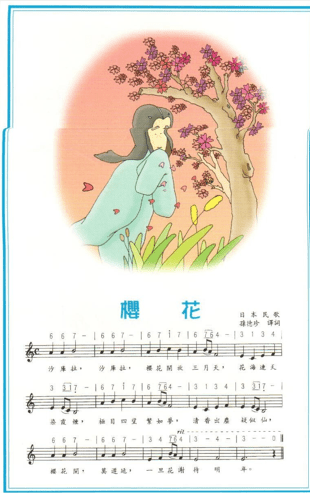
    櫻花開時好迷人!但櫻花一年只開一次,錯過了就要再等一年。
    幼兒期是一生中音樂能力建立的黃金時期,錯過此階段再也不易見到這種學習的輝煌效果。
    但若在此階段盲目灌輸樂理,會造成將來學習過程的瓶頸。

    English
    Cherry blossoms are enchanting — yet they bloom only once a year. Miss it, and you must wait another year.
    Early childhood is the golden period for developing musical ability. Missing this stage means the brilliance of such learning may never appear again.
    However, forcing theory too early can create obstacles in later musical learning.


    • 4. 互動過程 Interactive Activities

    一、遊戲 Game

    中文

    1. 全體圍成圓圈,玩「1 到 5」的報數遊戲。
    2. 不能有「2」出現(1,3,4,5,6)。
    3. 也不能有「5」出現(1,3,4,6,7)。

    English

    1. Have the children form a circle and play the “count from 1 to 5” game.
    2. The number “2” must not appear (sequence becomes 1,3,4,5,6).
    3. The number “5” must also not appear (sequence becomes 1,3,4,6,7).

    二、九宮格:五聲音階 Nine-Grid: Pentatonic Scale

    中文

    1. 幼兒分成五組,每組的代號分別是 1、3、4、6、7
    2. 各組看到老師指揮自己的代號時要報數。
    3. 各組以相當於代號的音磚取代報數,進行五聲音階遊戲。

    English

    1. Divide the children into five groups, each labeled 1, 3, 4, 6, 7.
    2. When the teacher signals their number, that group responds by counting aloud.
    3. Replace the counting with playing resonator bars corresponding to each number to practice the pentatonic scale.

    三、歌曲:櫻花 Song: Sakura

    中文

    1. 放錄音帶,告訴幼兒此單元的歌曲涵義:櫻花好美,但是一年只開一次,花開了不快點兒去看,花兒凋謝要等一年才看得到。
    2. 指揮幼兒作視奏:老師可以把曲中高音的 Do 和低音的 Si 自由補足旋律。
    3. 本歌曲主要是讓幼兒演奏,歌詞可視情況教或不教。

    English

    1. Play the recording and explain the song’s meaning: Cherry blossoms are beautiful, but they bloom only once a year. If you don’t hurry to see them, you’ll have to wait another year.
    2. Conduct the children in sight-reading: the teacher may freely add the high Do and low Si notes to complete the melody.
    3. This song is primarily for instrumental performance; teaching the lyrics is optional.

    • 5. 音樂特色解析 Musical Features

    中文

    • 採用日本式五聲音階(C, E, F, A, B, C’),省略 Re 和 Sol,呈現東方旋律之美。
    • 頑固伴奏:本曲以 Do–Mi–Fa–La–Si 重複的音型作為伴奏,形成穩定的背景,讓旋律在其上自由流動。
    • 九宮格活動結合遊戲與音階練習,幫助幼兒以動作體驗音高位置。
    • 以櫻花一年只開一次的意象,引導幼兒珍惜當下的美感經驗。
    • 文化比較
      • 中國五聲音階省略 Fa(媳婦)與 Si(未成年兒子),象徵文化中偏好和諧、穩定,不挑戰權威。
      • 日本五聲音階省略 Re(好好小姐)與 Sol(夫人),反而保留 Fa 與 Si 這兩個「極端音」,帶來張力與危機感,映照出日本文化對冒險、瞬間之美與未解張力的偏好。

    English

    • Uses the Japanese-style pentatonic scale (C, E, F, A, B, C’), omitting Re and Sol to highlight Eastern melodic beauty.
    • Stubborn accompaniment: This song employs a repeated Do–Mi–Fa–La–Si pattern as accompaniment, creating a stable background over which the melody can flow freely.
    • The nine-grid activity combines play and scale practice, allowing children to experience pitch placement through movement.
    • The imagery of cherry blossoms blooming only once a year helps children learn to cherish present aesthetic moments.
    • Cultural comparison:
      • The Chinese pentatonic scale omits Fa (daughter-in-law) and Si (immature son), reflecting a cultural preference for harmony and stability without challenging authority.
      • The Japanese pentatonic scale omits Re (the “good girl”) and Sol (matriarch), but retains Fa and Si — the “extreme tones” — creating tension and crisis, mirroring Japanese aesthetics of adventure and the poignancy of fleeting beauty.

    • 1. 單元目標 Unit Objectives

    中文
    單元目標:音階

    English
    Unit Focus: Scale awareness


    • 2. 教具 Teaching Aids

    中文
    鋼琴、音磚 E F A B C’

    English
    Piano, resonator bars E F A B C’


    • 3. 給老師和家長 For Teachers and Parents

    中文
    中國的五聲音階沒有 Fa 和 Si,本單元歌曲採用日本式五聲音階,其中 Re 和 Sol 兩音不用
    讓我們記得,小貓咪之所以能安然過橋,原因不是困難消失了,而是牠抓住要領:往前看,不要往下看,越害怕失敗,就越容易失敗。

    English
    The Chinese pentatonic scale omits Fa and Si. This song uses the Japanese pentatonic pattern, where Re and Sol are not used.
    Remember: the little kitten safely crossed the bridge not because the difficulty disappeared, but because it grasped the key point — look forward, not downward; the more afraid of failure you are, the more likely you are to fail.


    • 4. 故事 Story: 小貓咪過河

    中文
    有一隻小貓咪到馬戲團去學把戲,因為老師傅很嚴格,只要小貓咪做不好,就會挨打。
    小貓咪想起以前住在老婆婆家裡,不必學把戲就有東西吃,他開始懷念以前的日子。

    有一天,小貓咪學走繩子橋,老師傅一遍又一遍地教,小貓咪還是不敢走,因此老師傅就拿鞭子打牠。
    小貓咪被打得遍體鱗傷,決定要逃回去找老婆婆。

    小貓咪走啊走,看到一條河,河水流得很急,河上只有一個簡陋的吊橋。
    小貓咪想:「我如果過不去,一定會被抓回去,可是我又沒有把握。」

    這時候,他想起老師傅教他走繩子橋時說的話:
    「眼睛不要看下面,要往前看。」

    小貓咪穩穩地踩在吊橋上,眼睛往前看,不看下面的流水,也就不那麼害怕了。
    小貓咪安全地過了橋,回到老婆婆家。

    老婆婆看到小貓咪回來了,高興得不得了,就拿出小貓咪喜歡吃的東西餵牠。
    她看到小貓咪身上的傷痕,就為牠擦藥,並且剪了一塊布,為小貓咪做了一件可愛的小衣服。


    English
    A little kitten went to the circus to learn tricks. The old master there was very strict — if the kitten failed, it would be beaten.
    The kitten remembered its old life at the grandmother’s house, where it didn’t have to learn tricks to be fed. It longed for those days.

    One day, the kitten was practicing walking on a rope bridge. The master taught it again and again, but the kitten still dared not walk. So the master whipped it.
    Beaten and covered with wounds, the kitten decided to escape and find the grandmother.

    The kitten walked and walked until it reached a river. The water was rushing, and the only way across was a fragile hanging bridge.
    The kitten thought, “If I can’t cross, I’ll be caught again — but I’m not sure I can do it.”

    Then it remembered what the master had said when teaching it to walk the rope bridge:
    “Don’t look down. Look forward.”

    The kitten carefully stepped onto the hanging bridge. Looking forward and not at the rushing water below, it felt less afraid.
    Safely crossing, it returned to the grandmother’s house.

    When she saw the kitten, she was overjoyed. She brought out its favorite food, tended to its wounds, and cut a piece of cloth to sew a cute little coat for it.


    • 5. 歌曲教唱 Song Teaching

    中文

    1. 發給兩位幼兒各一片音磚,分別是 MiSi 音。告訴幼兒:當老師指揮到他時,要敲一下音磚。
      • 唱到小貓「」時,指揮 Mi 音磚
      • 唱到過河「西」時,指揮 Si 音磚
    2. C’、B、A、F、E 五個音磚,配合音樂讓幼兒進行一次頑固伴奏,也可以讓幼兒自己嘗試伴奏。

    English

    1. Give two children one resonator bar each — Mi and Si. Tell them: when the teacher points to you, strike your bar once.
      • When singing “kitten Mi,” point to the Mi bar.
      • When singing “crossing the bridge Si,” point to the Si bar.
    2. Use C’, B, A, F, E resonator bars to accompany the music, or let children try playing the accompaniment themselves.

    • 6. 音樂特色解析 Musical Features

    中文

    • 採用日本式五聲音階(E, F, A, B, C’),省略 Re 和 Sol,呈現獨特的東方音色。
    • 透過 Mi 和 Si 音的重複,引導幼兒感受旋律中的呼應與重點。
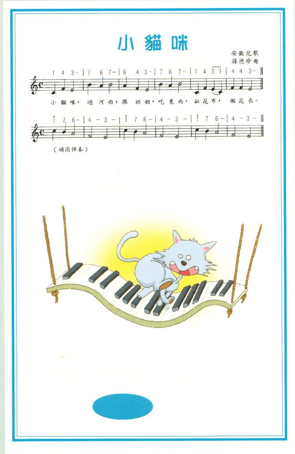
    • 頑固伴奏: 從樂譜中可看出「都希拉法米,都希拉法米」的固定重複,成為整首歌的背景伴奏,提供穩定的節奏與音型,幫助孩子在律動與歌唱中建立穩定感。
    • 藉故事情節與旋律結合,讓孩子在情境中體驗音階與情感變化。

    English

    • Uses the Japanese-style pentatonic scale (E, F, A, B, C’), omitting Re and Sol to create a distinctive Eastern color.
    • Repetition of Mi and Si tones helps children sense melodic responses and focal points.
    • Stubborn accompaniment: The score shows the repeating pattern “Do-Si-La-Fa-Mi, Do-Si-La-Fa-Mi,” which serves as the song’s background accompaniment, providing a stable rhythm and tone pattern that helps children feel grounded in both movement and singing.
    • Combines story and melody, enabling children to experience both the scale and emotional changes within a narrative context.


    • 1. 單元目標 Unit Objectives

    中文
    單元目標:長短

    English
    Unit Focus: Long and short phrases


    • 2. 教具 Teaching Aids

    中文
    音磚、九宮格、四宮格

    English
    Resonator bars, Nine-grid, Four-grid


    • 3. 律動化音樂欣賞 Move into Music

    中文
    本單元藉著各種鳥類的飛行和走路方式,讓幼兒從律動中體驗長樂句和短樂句、顫音和跳音,提醒幼兒直接從音樂中去感覺小鳥的動作。

    English
    This unit guides children to experience long and short phrases, trills, and staccato through the flying and walking movements of various birds. Children are encouraged to sense the birds’ actions directly through music.


    • 4. 故事 Story

    中文
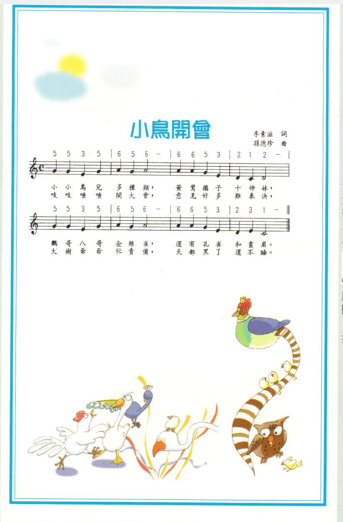
    鳥兒們開會要選鳥王,開會的當天,所有的鳥兒都到了,有鶴、雞、鵝、黃鶯、八哥、畫眉、麻雀、燕子、金絲雀、貓頭鷹、十姊妹、印度孔雀、長尾雉雞。
    由於好多小鳥都想要別人選牠當鳥王,因此誰也不讓誰,意見好多啊!從白天到晚上還沒有結果。
    大樹看了直搖頭說:「這麼晚了你們還不睡啊?」
    小鳥們說:「我們不知道該怎麼選啊!」
    大樹說:「你們不如每隻小鳥都表演一下飛的姿勢或走路的姿勢,看誰的姿勢最漂亮啊!」
    大家都同意,於是他們一個個都表演,有的飛得好快,有的飛得好慢,有的走得平穩,有的走得一跳一跳的,真是各有特色。
    結果長尾雉雞最漂亮又斯文,最後大家終於表決通過,選牠當鳥王。


    English
    The birds gathered for a meeting to choose their king. On the day of the meeting, all the birds arrived: the crane, chicken, goose, oriole, myna, thrush, sparrow, swallow, canary, owl, society finch, Indian peacock, and pheasant.
    Many birds wanted to be chosen as king, and no one would give way — there were so many opinions! From morning until night, they still couldn’t decide.
    The big tree shook its head and said, “It’s so late — why aren’t you sleeping?”
    The birds replied, “We don’t know how to choose!”
    The big tree suggested, “Why don’t each of you perform your flying or walking posture, and see whose is the most beautiful?”
    Everyone agreed. One by one, the birds performed: some flew very fast, some very slow; some walked steadily, some hopped as they went — each with unique traits.
    In the end, the pheasant was the most graceful and elegant, and everyone happily agreed to crown it as the bird king.


    • 5. 節奏練習 Rhythm Exercise (Four-Grid)

    中文
    本練習採用四宮格方式進行,所有字都放在四個脈動內。
    教師不直接講解節奏理論,而是讓孩子依鳥名字數(幾個字)進行律動,並用指揮引導他們自然完成節奏分配。

    操作步驟:

    1. 先出示鳥類圖片,讓孩子說出名字(幾個字)。
    2. 孩子一邊唸名字,一邊用手拍四個脈動。提醒孩子「用手唸出來」,讓語言與動作同步。
    3. 再換成節奏卡,孩子雖不看圖片,但心裡仍用「幾個字」來感受節奏。

    鳥名與脈動分配:

    • 一個字:鶴(長音,佔四脈動)
    • 兩個字:黃鶯(每字佔兩脈動)
    • 三個字:貓頭鷹(前三拍各一字,最後一拍延長)
    • 四個字:長尾雉雞(每字一拍)

    English
    This activity uses the four-grid method, fitting all words into four steady pulses.
    Teachers do not explain rhythm theory; instead, children respond to the number of syllables in bird names and naturally fit them into four pulses through guided movement.

    Steps:

    1. Show pictures of birds first; children say the names (syllable count).
    2. While saying the names, children tap four steady pulses with their hands. Remind them to “say it with your hands,” keeping speech and movement synchronized.
    3. Switch to rhythm cards; even without pictures, children still sense the rhythm through syllable count.

    Bird names and pulse distribution:

    • One syllable: Crane (long tone across four pulses)
    • Two syllables: Oriole (two pulses per syllable)
    • Three syllables: Owl (first three pulses one syllable each, last pulse extended)
    • Four syllables: Pheasant (one pulse per syllable)

    6. 歌曲教唱 Song

    中文
    (此部分可後續補入歌詞與旋律教學)

    English
    (This section can later include lyrics and melody teaching.)


    7. 律動化音樂欣賞 Move into Music

    中文
    欣賞聖桑《動物狂歡節(大鳥籠)》

    • 聽音樂想像小鳥飛的動作(上?下?快?慢?)
    • 聽音樂想像小鳥走路的動作(快?慢?大步?小步?)
    • 跟著音樂做相應的律動(飛翔、跳躍、走路)

    English
    Listen to Carnival of the Animals (Aviary) by Saint-Saëns:

    • Imagine birds flying (up? down? fast? slow?)
    • Imagine birds walking (fast? slow? big steps? little hops?)
    • Move along with the music, imitating the birds’ flying, hopping, or walking.

    • 8. 音樂特色解析 Musical Features

    中文

    • 結合長樂句與短樂句,體驗飛行與行走動作的對比。
    • 透過顫音表現小鳥的鳴叫與振翅,跳音展現輕快飛舞。
    • 律動與故事結合,幫助孩子在想像中理解音樂結構與情感。

    English

    • Combines long and short phrases to reflect the contrast between flying and walking.
    • Uses trills to portray birds’ chirping and fluttering, and staccato to show light, playful flight.
    • Integrates movement and storytelling, helping children grasp musical form and expression through imagination.

    1. 單元目標 Unit Focus

    中文
    單元目標:重音

    English
    Focus: Accents (strong beats)


    2. 給老師和家長 For Teachers and Parents

    中文
    本單元藉欣賞《動物狂歡節》中的「長耳人」抓樹藤的動作(不規律拍、重音),讓幼兒認識音樂中的重音。

    English
    This unit introduces accents in music through listening to “Characters with Long Ears” from Carnival of the Animals. The jumping and grabbing motions of the “long-eared figure” help children experience accented beats in an irregular rhythmic pattern.


    3. 資料庫、律動、欣賞 Cultural Note, Movement, and Listening

    中文
    聆聽《動物狂歡節(長耳人)》,聽聽音樂中長耳人跳起來抓住樹藤(重音),跟著音樂學長耳人抓,抓的動作要快,不然就掉下去了。

    English
    Listen to Carnival of the Animals (Characters with Long Ears) and notice the accented notes where the long-eared figure jumps up to grab the vines. Children imitate this motion — the grab must be quick, or they “fall” if they miss the beat.


    4. 故事 Story: 長耳人

    中文
    有個人他有一隻小狗,耳朵長長的,尾巴短短的,好可愛。
    有一天,他遇到一位巫婆,巫婆說:「把你的這小狗給我,不然我就把你變成怪物。」
    這個人不肯,於是巫婆就施了咒語,使他變成一隻長耳人。
    太陽出來時,他就會變成長耳人,只要太陽下山,他就變回原來的樣子。
    他的小狗看到他的怪樣子,認不出來就跑掉了。
    長耳人好傷心,他到處找,可是森林好大,他怎麼找呢?
    有了,他學猴子跳上樹,抬頭看看,有好多樹藤,用力一抓,盪過去,再用力抓另外一根到一邊去。
    小狗躲起來,他聽到長耳人在找他,哦,越來越靠近了,怎麼辦,快躲好。
    這邊長耳人找不到小狗,再到另一邊去,越跳越遠了。


    English
    Once there was a man who had a little dog with long ears and a short tail — very cute indeed.
    One day, he met a witch who said, “Give me your little dog, or I will turn you into a monster!”
    The man refused, so the witch cast a spell and turned him into a long-eared creature.
    When the sun rose, he became the long-eared creature; when the sun set, he turned back into himself.
    But his little dog didn’t recognize him in this strange form and ran away.
    The long-eared creature was heartbroken. He searched everywhere, but the forest was huge — how could he find his dog?
    Then he got an idea: he climbed trees like a monkey, looked up, saw many vines, grabbed one, swung across, and grabbed another to keep going.
    Meanwhile, the little dog was hiding. The creature heard the dog nearby — closer and closer! What to do? Quickly hide!
    When he couldn’t find the dog in one place, he leapt to another, farther and farther away.


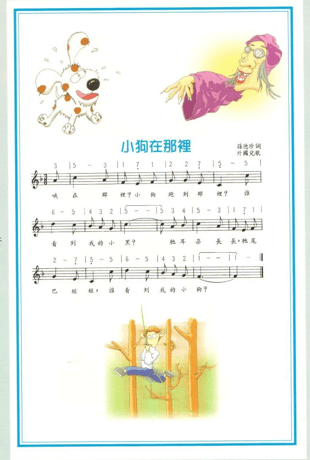
    5. 遊戲 Game: 小狗在那裡 Little Dog, Where Are You?

    中文

    1. 全體圍成一個圓圈,請一位幼兒到圈外當長耳人。
    2. 指定一位幼兒當小狗,不要讓長耳人知道。遊戲開始時大家一起唱「小狗在那裡」,小狗帶大家做動作。長耳人進入圈中尋找,如果他走近「小狗」,大家要越唱越大聲;長耳人走遠,則越唱越小聲。
    3. 猜中誰是小狗,長耳人就可以回來,換小狗出去當長耳人,圓圈裡的幼兒再選一人當小狗,以此類推。

    English

    1. Children form a circle. One child stands outside the circle as the “long-eared creature.”
    2. Secretly assign one child inside the circle to be the “little dog.” At the start, everyone sings Little Dog, Where Are You? The “dog” leads the group’s movements. As the long-eared creature searches, the singing gets louder when closer to the dog, and softer when farther away.
    3. When the creature correctly identifies the dog, they switch roles: the dog becomes the seeker, and another child is chosen to be the new dog.

    6. 音樂特色解析 Musical Features

    中文

    • 以重音表現動作的突然發力,如長耳人抓樹藤時的跳躍與用力。
    • 透過強弱對比和不規律的拍點,營造尋找與驚險的戲劇氛圍。
    • 結合聆聽、動作與故事,引導幼兒在遊戲中感受重音與節奏變化。

    English

    • Accented notes depict sudden bursts of energy, such as the long-eared figure leaping and grabbing vines.
    • Strong-weak contrasts and irregular rhythms create a playful yet suspenseful atmosphere.
    • Combining listening, movement, and storytelling allows children to experience accents and rhythmic shifts through interactive play.

  • 1. 單元目標 Unit Focus

    中文
    單元目標:強弱
    教具:節奏樂器

    English
    Focus: Dynamics (strong and weak)
    Teaching Tools: Rhythm instruments


    2. 給老師和家長 For Teachers and Parents

    中文
    所有幼兒都喜歡迪士尼的卡通影片,因為它滿足幼兒的想像世界:擬人化的動物、戲劇化的生活,加上配樂自然、生活化。集體遊戲比「用聲音說故事」更能使幼兒投入戲劇中,較害羞的孩子此時會轉移注意力變得較放得開。

    English
    Children love Disney cartoons because they capture their imaginative world — anthropomorphic animals, playful storytelling, and natural, life-like music. Group games that combine storytelling and sound engage children deeply; even shy children can shift their focus and join in more freely.


    3. 歌曲 Song

    中文
    小老鼠 上燈台,
    偷油吃 下不來,
    叫媽媽 媽不來,
    大貓來了,
    嚓哩咔嚓滾下來。

    English (Note)
    Lyrics are kept in Chinese to preserve the cultural rhythm and playful imagery of the rhyme. Teachers can add hand motions or dynamic contrasts (soft for “sneaking,” loud for “cat”) to enhance storytelling.


    4. 資料庫 Cultural Note

    中文
    兒歌〈小老鼠〉源於傳統童謠,描述一隻貪吃的小老鼠爬上燈台偷油,因為害怕與驚嚇而掉下來。這種誇張的情節與擬聲字的運用(如「嚓哩咔嚓」)吸引幼兒的注意,適合用於聲音模仿與動作遊戲。

    English
    The rhyme Little Mouse comes from a traditional children’s song describing a mischievous mouse climbing a lampstand to steal oil, then falling in fright when the cat arrives. The playful use of onomatopoeia (e.g., “cha-li-ka-cha”) captures children’s attention and works well for sound imitation and movement games.


    5. 互動過程 Interactive Activity

    中文

    1. 講故事
    • 引導者講「小老鼠上燈台」的故事。
    • 讓幼兒視覺化故事,並整理故事的順序。
    1. 哼兒歌〈小老鼠〉(見資料庫)
    • 教幼兒唱這首兒歌,並儘量背誦。
    1. 分析語音
    • 上燈台是怎樣的聲音?偷偷摸摸的還是很大聲的?在鐵琴上作出上爬的聲音該怎麼奏?(上行音階)
    • 下不來的時候,可以用怎樣的聲音?(高反覆或八度音頓伴奏)
    • 叫媽媽的聲音可以用哪兩個音表示?(CACA 媽媽媽媽)
    • 大貓來了,很可怕,用怎樣的聲音?(敲擊強音)
    • 「嚓哩咔嚓」滾下來的聲音該怎麼奏?(鐵琴快速下行音階)
    1. 配詞和角色
    • 分配角色,並決定配樂內容。
    • 先讓兒童一起唱第一句,然後配第一段音樂,依次每唱一句加上該段音響。

    English

    1. Storytelling
    • Tell the story of “Little Mouse on the Lampstand.”
    • Encourage children to visualize the sequence of events and retell them in order.
    1. Singing the Rhyme
    • Teach children to hum and sing Little Mouse, aiming for memorization.
    1. Exploring Sounds
    • How should climbing the lampstand sound? Quiet or loud? Recreate climbing with ascending xylophone notes.
    • How should “can’t come down” sound? Try repeated high notes or octave jumps.
    • Represent “calling mama” with two alternating notes (C-A-C-A).
    • For “the big cat arrives,” use strong percussion to create a sense of fear.
    • For “cha-li-ka-cha rolling down,” play a fast descending scale on the xylophone.
    1. Assigning Roles and Music
    • Assign character roles and decide on matching sounds.
    • Have children sing the first line together, then add sound effects for each line, building the story musically.

    6. 音樂特色解析 Musical Features

    中文

    • 本曲以強弱對比呈現故事情境:小老鼠偷偷摸摸時聲音輕,大貓出現時聲音強烈。
    • 運用上行與下行音階模擬老鼠爬上與滾下的動作,讓音高變化與故事動作緊密連結。
    • 擬聲字「嚓哩咔嚓」引導幼兒探索節奏與聲音模仿,增添音樂遊戲性。

    English

    • The song uses dynamic contrast to portray the story: soft for the mouse sneaking, loud for the cat’s arrival.
    • Ascending and descending scales imitate the mouse climbing up and tumbling down, linking pitch movement to storytelling.
    • The onomatopoeia “cha-li-ka-cha” invites children to explore rhythm and sound effects, adding playful creativity to the activity.

    1. 單元目標 Unit Focus

    中文
    單元目標:長短
    教具:音磚 C D E F G

    English
    Focus: Long and short note values
    Teaching Tools: Tone bars C D E F G


    2. 給老師和家長 For Teachers and Parents

    中文
    唱本單元歌曲時,每一句句尾的長音,都要搖動尾巴四下,讓幼兒學習音符的音長,並使其養成足拍的觀念。

    English
    When singing this song, children should sway their “tails” four times on each phrase’s final long note. This helps them internalize note durations and develop a steady sense of beat.


    3. 歌曲 Song

    中文
    一隻蝌蚪一個頭,兩隻眼睛黑黝黝,
    一條尾巴在後頭,搖搖擺擺水裡游。

    English (Note)
    Lyrics are presented in Chinese to maintain the rhyme and imagery. The melody aligns with the natural rhythm of Mandarin, supporting children’s singing by ear.


    4. 資料庫 Cultural Note

    中文
    故事:小蝌蚪尋友記
    從前在一個小池塘裡,住著幾雙小蝌蚪,其中最聰明的一隻小蝌蚪名字叫「多多」。
    有一天,天空下起大雨,多多住的池塘很快就淹滿了水,所有蝌蚪都被大雨沖散了。
    多多拼命游呀游,終於游到一條小溪裡。他想起了被沖散的好朋友,忍不住流下淚來。
    這時候剛好有一隻青蛙路過,就問他:「孩子,你為什麼哭呢?」
    多多說:「我現在一個朋友都沒有了。」
    青蛙說:「怎麼會呢?這條小溪往前去沒多遠,就住著好多好多蝌蚪呢,你應該去找一找新朋友,而不要在這裡哭啊!」
    多多擦乾眼淚,繼續往前游,終於看到好多小蝌蚪。
    他好開心,因為他又有新朋友了。


    English
    Story: Little Tadpole’s Search for Friends
    Once upon a time, in a small pond, lived several little tadpoles. The smartest one was named Dodo.
    One day, heavy rain began to fall, and the pond where Dodo lived quickly overflowed. All the tadpoles were scattered by the storm.
    Dodo swam desperately until he reached a small stream. Thinking of his lost friends, he couldn’t help but cry.
    Just then, a frog passed by and asked, “Child, why are you crying?”
    “I don’t have any friends anymore,” Dodo replied.
    The frog said, “That can’t be true! Not far ahead along this stream, there are many, many tadpoles living there. You should go and find new friends instead of staying here to cry.”
    Dodo wiped away his tears and kept swimming forward until he saw many other tadpoles.
    He was so happy — he had found new friends again.


    5. 互動過程 Interactive Activity

    中文

    1. 故事
      將導言轉為小蝌蚪的故事,並讓幼兒聽。
    2. 律動
    • 將蝌蚪放在肩上或手掌上,讓幼兒邊唱邊搖尾巴。
    • 幼兒學習在歌曲的長音處搖動尾巴四下,每句句尾延長兩拍(共四下尾巴)。
    1. 歌唱
      幼兒在律動中練習唱歌,注意句尾的長音。

    English

    1. Story
      Introduce the song by telling the tadpole’s story, preparing children for the theme of friendship and movement.
    2. Movement
    • Place a pretend tadpole on the shoulder or palm; children sway their “tails” while singing.
    • On each phrase’s long note, children sway four times, reinforcing the concept of sustained notes (two beats).
    1. Singing
      Children sing the melody while performing the tail-swaying motion, focusing on the long note at the end of each phrase.

    6. 音樂特色解析 Musical Features

    中文

    • 本曲藉由長音與短音的對比,讓幼兒透過搖尾巴感受音符時值與節拍。
    • 歌詞描寫蝌蚪的外觀與動作,將自然觀察融入音樂學習。
    • 歌曲結構簡單,適合搭配律動遊戲與故事延伸,幫助幼兒在遊戲中理解節奏與音長。

    English

    • The song contrasts long and short notes, inviting children to feel note duration and steady beat through tail-swaying motions.
    • Lyrics describe the tadpole’s appearance and movement, integrating nature observation with music learning.
    • Its simple structure works well with movement games and storytelling, helping children grasp rhythm and note length through play.

    1. 單元目標 Unit Focus

    中文
    單元目標:上行
    教具:節奏樂器

    English
    Focus: Ascending melodic motion
    Teaching Tools: Rhythm instruments


    2. 給老師和家長 For Teachers and Parents

    中文
    旋律進行的三個主要方向為:上行、下行以及同音反覆。瞭解這一點,創作過程不再是一個一個音符的拼湊,整個創作的過程會自然而愉快許多。

    English
    Melodic movement can progress in three primary ways: upward, downward, or repeated pitches. Recognizing this principle helps teachers and children create melodies more naturally, turning composition from piecing notes together into a joyful process.


    3. 歌曲 Song

    中文
    (保持你提供的歌詞原文)

    English (Note)
    Lyrics are kept in Chinese to preserve the original phrasing and tonal qualities of the song. This melody is widely known internationally as Itsy Bitsy Spider.


    4. 資料庫 Cultural Note

    中文
    故事:小蜘蛛
    就像中國母親陪伴孩子一起玩「小雞喝水」,美國的母親也有類似的歌,就是《小蜘蛛》。美國的媽媽教她的孩子唱這首歌,一面唱一面做動作,同時也教她的孩子不要怕困難,要學蜘蛛的精神,失敗了重新再來。

    韻律活動

    1. 兩手手指張開,手心朝正前方;右手拇指拉在左手小指上方,再把左手拇指拉在右手小指上方,小指橫扭成蜘蛛在爬的動作。
    2. 從最下部做風吹雨打慢慢下蹲的動作。
    3. 兩臂平伸身體上浮如太陽昇起。
    4. 兩手恢復像韻律句一的爬行動作。

    English
    Story: Little Spider
    Similar to how Chinese mothers play “Little Chick Drinks Water” with their children, American mothers have a comparable song, Itsy Bitsy Spider. Mothers sing this song with hand motions, teaching children both music and resilience — like the spider, who climbs again after falling.

    Rhythmic Movements

    1. Open both hands, fingers spread, palms facing forward. Cross the thumbs and little fingers alternately to imitate the spider climbing upward.
    2. Slowly squat down to mimic the rain falling.
    3. Stretch arms out to the sides and rise upward, like the sun coming out.
    4. Return to the original climbing motion (same as step 1).

    5. 互動過程 Interactive Activity

    中文

    1. 故事
      《小蜘蛛》是一首美國的傳統兒歌(見資料庫),引導者可運用歌詞編成簡短故事,說給幼兒聽。
    2. 歌曲
      學唱《小蜘蛛》,歌曲及律動,注意每小節有兩拍,小蜘蛛要往上爬兩步。
    3. 感覺複拍子的律動
      老師可以在間奏讓幼兒以張開手掌的動作感受複拍子的律動。(每小節做兩次)

    English

    1. Story
      Little Spider is a traditional American children’s song (see Cultural Note). The teacher can turn the lyrics into a brief story and tell it to the children before singing.
    2. Song
      Teach the children to sing Little Spider with movements. Emphasize that each measure has two beats, and the spider climbs upward for two steps.
    3. Feeling Duple Meter
      During the interlude, invite children to open their hands and feel the beat with a clapping motion, reinforcing the two-beat structure.

    6. 音樂特色解析 Musical Features

    中文

    • 本曲透過旋律的上行與下行表現蜘蛛攀爬、雨落與太陽升起的動作,將動作與音高緊密結合。
    • 讓幼兒以手指交錯爬行的方式,自然體驗複拍子的節奏感。
    • 歌曲源於美國童謠,但透過動作教學與故事轉化,讓不同文化背景的幼兒都能共鳴。

    English

    • The melody uses ascending and descending motion to depict the spider’s climbing, the falling rain, and the rising sun, closely linking movement with pitch.
    • The crossing-finger climbing action helps children naturally experience the feeling of duple meter.
    • Although the song originates from an American folk rhyme, its storytelling and movement approach resonate with children from various cultural backgrounds.

    1. 單元目標 Unit Focus

    中文
    單元目標:樂句
    教具:鋼琴

    English
    Focus: Musical phrases
    Teaching Tool: Piano


    2. 給老師和家長 For Teachers and Parents

    中文
    本單元歌曲是以鋼琴三黑鍵的音配合中文童謠寫成的三音旋律。藉著三個音的上下流動與所停的音不同,讓幼兒感覺兩樂句不同語氣(問句、答句)。

    English
    This unit uses a three-note melody on the black keys of the piano, paired with a traditional Chinese children’s rhyme. The upward and downward movement of the notes, along with the resting tones, helps children sense the contrasting moods of the two phrases — the question and the answer.


    3. 故事 Story

    中文
    老師說故事:
    從前有隻小蜈蚣,牠有好多雙腳。牠學會本領,可以往前走,也可以轉過身來往後走,覺得很得意。
    新年到了,大家都穿新衣、穿新鞋,小蜈蚣也想買新鞋。牠試穿新鞋時,一隻隻腳輪流提起,把鞋穿上去,看了看覺得不滿意,再一隻隻腳輪流提起,把鞋脫下來。試了好幾款新鞋後,小蜈蚣終於找到自己喜歡的鞋子了。

    English
    Teacher’s Storytelling:
    Once upon a time, there was a little centipede with many pairs of legs. It learned how to walk forward and also turn around to walk backward, which made it feel very proud.
    When the New Year came, everyone wore new clothes and new shoes. The little centipede also wanted new shoes. It tried them on one by one — lifting each leg to put the shoes on — but wasn’t satisfied. It lifted each leg again to take them off. After trying many pairs, the centipede finally found the shoes it loved.


    4. 歌曲 Song

    中文
    老師說:「小蜈蚣,小蜈蚣,你有幾雙腳呀?」(問)
    小蜈蚣說:「多得很,多得很,請你數一數。」(答)

    English (Note)
    Lyrics are presented in Chinese to preserve cultural tone and rhythm. The melody mirrors the natural rise and fall of the Mandarin question-and-answer phrases.


    5. 遊戲 Game: 小蜈蚣買鞋 Little Centipede Buys Shoes

    中文

    1. 全班排成一長排,每個人手搭前面人的腰,請最前面和最後面的人當小蜈蚣的頭、尾。老師當鞋店的老闆。
    2. 一起唱本單元歌曲。唱完第一句「你有幾雙腳啊?」全體向後轉,轉身再走;唱完第二句「請你數一數」時,老師說:「我來數數看 1, 2, 3, 4, 5……」,全體跟著數到最後一位幼兒為止。
    3. 老師說:「沒那麼多,我只有三雙。」(比人數少)
    4. 報數超過的幼兒,就是沒有鞋子穿的,要立刻離開隊伍,再變成一隻小蜈蚣。
    5. 如果老師說:「我要一次賣六雙。」(比人數多)小蜈蚣的頭要再去拉人,湊足腳數。

    English

    1. Children line up, holding the waist of the person in front to form a “centipede.” The first and last children are the head and tail; the teacher plays the shoe shop owner.
    2. Sing the song together. After the first phrase (“How many legs do you have?”), the centipede turns around and walks in the opposite direction. After the second phrase (“Please count them”), the teacher counts aloud (“1, 2, 3, 4, 5…”), and the children count along until the last child.
    3. The teacher may say, “I don’t have that many shoes — only three pairs!” (fewer than the children’s count).
    4. Any children beyond the counted number “don’t have shoes” and must leave the centipede to form a new one.
    5. If the teacher says, “I want to sell six pairs at once!” (more than the children’s count), the centipede’s head goes to invite more children to join and complete the number.

    6. 音樂特色解析 Musical Features

    中文

    • 旋律緊貼中文聲調,讓孩子以語感唱準音高,體驗「說話就是唱歌」。
    • 問句結尾落在屬和弦,如問號般製造懸念;答句結尾回到主和弦,如句號般帶來安定。
    • 採三個黑鍵設計,幼兒用 2、3、4 指彈奏,拇指與小指自然落在白鍵,輕鬆建立鋼琴學習基礎。

    English

    • The melody follows the natural tones of Chinese speech, allowing children to sing in tune by ear — speaking becomes singing.
    • The question phrase ends on the dominant chord (like a question mark), creating suspense; the answer phrase resolves to the tonic (like a period), bringing closure.
    • The song uses three black keys, played with fingers 2, 3, and 4, while the thumb and little finger rest on white keys — a relaxed starting point for piano beginners.