- 1. 單元目標 Unit Objectives
中文
單元目標:音階
English
Unit Focus: Scale awareness
- 2. 教具 Teaching Aids
中文
音磚 C, E, F, A, B, C’
English
Resonator bars C, E, F, A, B, C’
- 3. 給老師和家長 For Teachers and Parents
中文
櫻花開時好迷人!但櫻花一年只開一次,錯過了就要再等一年。
幼兒期是一生中音樂能力建立的黃金時期,錯過此階段再也不易見到這種學習的輝煌效果。
但若在此階段盲目灌輸樂理,會造成將來學習過程的瓶頸。
English
Cherry blossoms are enchanting — yet they bloom only once a year. Miss it, and you must wait another year.
Early childhood is the golden period for developing musical ability. Missing this stage means the brilliance of such learning may never appear again.
However, forcing theory too early can create obstacles in later musical learning.
- 4. 互動過程 Interactive Activities
一、遊戲 Game
中文
- 全體圍成圓圈,玩「1 到 5」的報數遊戲。
- 不能有「2」出現(1,3,4,5,6)。
- 也不能有「5」出現(1,3,4,6,7)。
English
- Have the children form a circle and play the “count from 1 to 5” game.
- The number “2” must not appear (sequence becomes 1,3,4,5,6).
- The number “5” must also not appear (sequence becomes 1,3,4,6,7).
二、九宮格:五聲音階 Nine-Grid: Pentatonic Scale
中文
- 幼兒分成五組,每組的代號分別是 1、3、4、6、7。
- 各組看到老師指揮自己的代號時要報數。
- 各組以相當於代號的音磚取代報數,進行五聲音階遊戲。
English
- Divide the children into five groups, each labeled 1, 3, 4, 6, 7.
- When the teacher signals their number, that group responds by counting aloud.
- Replace the counting with playing resonator bars corresponding to each number to practice the pentatonic scale.
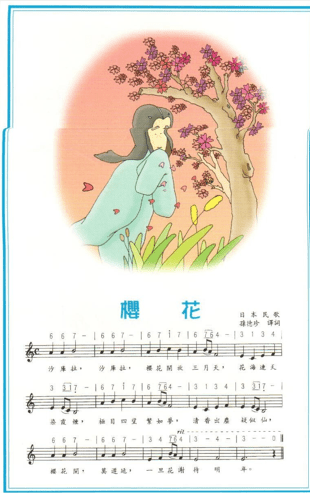
三、歌曲:櫻花 Song: Sakura
中文
- 放錄音帶,告訴幼兒此單元的歌曲涵義:櫻花好美,但是一年只開一次,花開了不快點兒去看,花兒凋謝要等一年才看得到。
- 指揮幼兒作視奏:老師可以把曲中高音的 Do 和低音的 Si 自由補足旋律。
- 本歌曲主要是讓幼兒演奏,歌詞可視情況教或不教。
English
- Play the recording and explain the song’s meaning: Cherry blossoms are beautiful, but they bloom only once a year. If you don’t hurry to see them, you’ll have to wait another year.
- Conduct the children in sight-reading: the teacher may freely add the high Do and low Si notes to complete the melody.
- This song is primarily for instrumental performance; teaching the lyrics is optional.
- 5. 音樂特色解析 Musical Features
中文
- 採用日本式五聲音階(C, E, F, A, B, C’),省略 Re 和 Sol,呈現東方旋律之美。
- 頑固伴奏:本曲以 Do–Mi–Fa–La–Si 重複的音型作為伴奏,形成穩定的背景,讓旋律在其上自由流動。
- 九宮格活動結合遊戲與音階練習,幫助幼兒以動作體驗音高位置。
- 以櫻花一年只開一次的意象,引導幼兒珍惜當下的美感經驗。
- 文化比較:
- 中國五聲音階省略 Fa(媳婦)與 Si(未成年兒子),象徵文化中偏好和諧、穩定,不挑戰權威。
- 日本五聲音階省略 Re(好好小姐)與 Sol(夫人),反而保留 Fa 與 Si 這兩個「極端音」,帶來張力與危機感,映照出日本文化對冒險、瞬間之美與未解張力的偏好。
English
- Uses the Japanese-style pentatonic scale (C, E, F, A, B, C’), omitting Re and Sol to highlight Eastern melodic beauty.
- Stubborn accompaniment: This song employs a repeated Do–Mi–Fa–La–Si pattern as accompaniment, creating a stable background over which the melody can flow freely.
- The nine-grid activity combines play and scale practice, allowing children to experience pitch placement through movement.
- The imagery of cherry blossoms blooming only once a year helps children learn to cherish present aesthetic moments.
- Cultural comparison:
- The Chinese pentatonic scale omits Fa (daughter-in-law) and Si (immature son), reflecting a cultural preference for harmony and stability without challenging authority.
- The Japanese pentatonic scale omits Re (the “good girl”) and Sol (matriarch), but retains Fa and Si — the “extreme tones” — creating tension and crisis, mirroring Japanese aesthetics of adventure and the poignancy of fleeting beauty.
 雅歌教育典藏站
發表留言