- 1. 單元目標 Unit Objectives
中文
單元目標:長短
English
Unit Focus: Long and short phrases
- 2. 教具 Teaching Aids
中文
音磚、九宮格、四宮格
English
Resonator bars, Nine-grid, Four-grid
- 3. 律動化音樂欣賞 Move into Music
中文
本單元藉著各種鳥類的飛行和走路方式,讓幼兒從律動中體驗長樂句和短樂句、顫音和跳音,提醒幼兒直接從音樂中去感覺小鳥的動作。
English
This unit guides children to experience long and short phrases, trills, and staccato through the flying and walking movements of various birds. Children are encouraged to sense the birds’ actions directly through music.
- 4. 故事 Story
中文
鳥兒們開會要選鳥王,開會的當天,所有的鳥兒都到了,有鶴、雞、鵝、黃鶯、八哥、畫眉、麻雀、燕子、金絲雀、貓頭鷹、十姊妹、印度孔雀、長尾雉雞。
由於好多小鳥都想要別人選牠當鳥王,因此誰也不讓誰,意見好多啊!從白天到晚上還沒有結果。
大樹看了直搖頭說:「這麼晚了你們還不睡啊?」
小鳥們說:「我們不知道該怎麼選啊!」
大樹說:「你們不如每隻小鳥都表演一下飛的姿勢或走路的姿勢,看誰的姿勢最漂亮啊!」
大家都同意,於是他們一個個都表演,有的飛得好快,有的飛得好慢,有的走得平穩,有的走得一跳一跳的,真是各有特色。
結果長尾雉雞最漂亮又斯文,最後大家終於表決通過,選牠當鳥王。
English
The birds gathered for a meeting to choose their king. On the day of the meeting, all the birds arrived: the crane, chicken, goose, oriole, myna, thrush, sparrow, swallow, canary, owl, society finch, Indian peacock, and pheasant.
Many birds wanted to be chosen as king, and no one would give way — there were so many opinions! From morning until night, they still couldn’t decide.
The big tree shook its head and said, “It’s so late — why aren’t you sleeping?”
The birds replied, “We don’t know how to choose!”
The big tree suggested, “Why don’t each of you perform your flying or walking posture, and see whose is the most beautiful?”
Everyone agreed. One by one, the birds performed: some flew very fast, some very slow; some walked steadily, some hopped as they went — each with unique traits.
In the end, the pheasant was the most graceful and elegant, and everyone happily agreed to crown it as the bird king.
- 5. 節奏練習 Rhythm Exercise (Four-Grid)
中文
本練習採用四宮格方式進行,所有字都放在四個脈動內。
教師不直接講解節奏理論,而是讓孩子依鳥名字數(幾個字)進行律動,並用指揮引導他們自然完成節奏分配。
操作步驟:
- 先出示鳥類圖片,讓孩子說出名字(幾個字)。
- 孩子一邊唸名字,一邊用手拍四個脈動。提醒孩子「用手唸出來」,讓語言與動作同步。
- 再換成節奏卡,孩子雖不看圖片,但心裡仍用「幾個字」來感受節奏。
鳥名與脈動分配:
- 一個字:鶴(長音,佔四脈動)
- 兩個字:黃鶯(每字佔兩脈動)
- 三個字:貓頭鷹(前三拍各一字,最後一拍延長)
- 四個字:長尾雉雞(每字一拍)
English
This activity uses the four-grid method, fitting all words into four steady pulses.
Teachers do not explain rhythm theory; instead, children respond to the number of syllables in bird names and naturally fit them into four pulses through guided movement.
Steps:
- Show pictures of birds first; children say the names (syllable count).
- While saying the names, children tap four steady pulses with their hands. Remind them to “say it with your hands,” keeping speech and movement synchronized.
- Switch to rhythm cards; even without pictures, children still sense the rhythm through syllable count.
Bird names and pulse distribution:
- One syllable: Crane (long tone across four pulses)
- Two syllables: Oriole (two pulses per syllable)
- Three syllables: Owl (first three pulses one syllable each, last pulse extended)
- Four syllables: Pheasant (one pulse per syllable)
6. 歌曲教唱 Song
中文
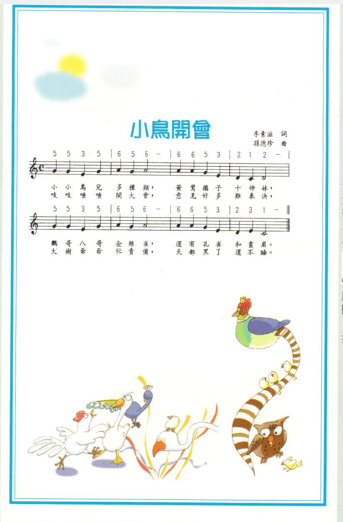
(此部分可後續補入歌詞與旋律教學)
English
(This section can later include lyrics and melody teaching.)
7. 律動化音樂欣賞 Move into Music
中文
欣賞聖桑《動物狂歡節(大鳥籠)》
- 聽音樂想像小鳥飛的動作(上?下?快?慢?)
- 聽音樂想像小鳥走路的動作(快?慢?大步?小步?)
- 跟著音樂做相應的律動(飛翔、跳躍、走路)
English
Listen to Carnival of the Animals (Aviary) by Saint-Saëns:
- Imagine birds flying (up? down? fast? slow?)
- Imagine birds walking (fast? slow? big steps? little hops?)
- Move along with the music, imitating the birds’ flying, hopping, or walking.
- 8. 音樂特色解析 Musical Features
中文
- 結合長樂句與短樂句,體驗飛行與行走動作的對比。
- 透過顫音表現小鳥的鳴叫與振翅,跳音展現輕快飛舞。
- 律動與故事結合,幫助孩子在想像中理解音樂結構與情感。
English
- Combines long and short phrases to reflect the contrast between flying and walking.
- Uses trills to portray birds’ chirping and fluttering, and staccato to show light, playful flight.
- Integrates movement and storytelling, helping children grasp musical form and expression through imagination.
 雅歌教育典藏站
發表留言