1. 單元目標 Unit Focus
中文
單元目標:高低
教具:音磚 E、A
English
Focus: High and low pitch
Teaching Tools: Tone bars E and A
2. 給老師和家長 For Teachers and Parents
中文
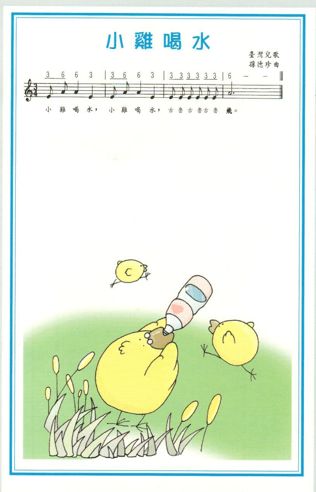
本歌曲是以二音音階(E、A)所譜成,中文語音的第一聲和第三聲組成一個完全四度,老師可以根據此原則創作類似的歌詞。
English
This song is written using a two-note scale (E and A). The first and third tones of Mandarin form a perfect fourth, which serves as the melodic framework. Teachers can use this principle to create similar lyrics for classroom activities.
3. 歌曲 Song
中文
小雞喝水,小雞喝水,咕魯咕魯咕魯飛。
English (Note)
Lyrics are presented in Chinese to preserve their rhythmic and tonal qualities. The song in this textbook uses a Mandarin version, though the original folk rhyme exists in Taiwanese Hokkien.
4. 資料庫 Cultural Note
中文
這首臺灣兒歌原以臺語發音,歌詞為:「雞仔吃水,雞仔啄穀,古古古古古古飛。」
傳統中的母親和自己的愛子玩此遊戲時,兩手握住幼兒的兩手,使幼兒左手掌張開,右手伸出食指當作小雞的嘴,在左手掌心內吃食。當吃喝完畢後,兩手上揚作展翅飛的動作。
English
This Taiwanese children’s song was originally sung in Hokkien, with lyrics describing a chick drinking water and pecking at grains. Traditionally, mothers would hold their child’s hands, open the left palm, and use the right index finger as the chick’s beak to mimic pecking. At the end, both hands are lifted to imitate the flapping wings of a chick about to fly. The version used in this textbook adapts the melody to Mandarin lyrics.
5. 互動過程 Interactive Activity
中文
- 遊戲:老師哼兒歌「小雞喝水」,並引導幼兒一邊哼,一邊用手玩此遊戲。(見資料庫)
- 歌曲:跟著音樂做手指的遊戲。
- 演奏:讓幼兒在音磚E和音磚A上找到此曲的曲調。
English
- Game: The teacher hums the song Little Chick Drinks Water and guides the children to hum along while playing the hand game described in the cultural note.
- Song: Children sing the melody while performing the finger-play movements.
- Instrument Play: Invite children to find the melody using tone bars E and A, exploring high and low sounds.
6. 音樂特色解析 Musical Features
中文
- 本曲僅用二音組成,以 E 與 A 的完全四度呈現高低音對比,適合幼兒初步感受音高差異。
- 透過臺灣傳統手遊與歌謠結合,讓幼兒在動作中體驗音樂節奏與高低變化。
- 歌曲結構簡短,方便教師即興延伸或創作以**第一聲、第三聲(動物)**的動作歌謠。
- 此曲同時也是鋼琴的預備姿勢訓練:透過手掌張開、食指點擊的動作,幫助幼兒建立手指靈活度與手型控制。
English
- The melody uses only two notes (E and A), forming a perfect fourth to highlight the contrast between high and low pitches — ideal for beginners to experience pitch differences.
- The song blends a traditional Taiwanese hand game with music, allowing children to feel rhythm and pitch through playful movements.
- Its simple structure makes it easy for teachers to improvise or create new animal action songs using first and third tones of Mandarin.
- This song also serves as preparatory piano training: the open palm and tapping finger motions help children develop finger flexibility and hand-shape control at the keyboard.
 雅歌教育典藏站
發表留言