- 1. 單元目標 Unit Objectives
中文
單元目標:音階
English
Unit Focus: Scale awareness
- 2. 教具 Teaching Aids
中文
鋼琴、音磚 E F A B C’
English
Piano, resonator bars E F A B C’
- 3. 給老師和家長 For Teachers and Parents
中文
中國的五聲音階沒有 Fa 和 Si,本單元歌曲採用日本式五聲音階,其中 Re 和 Sol 兩音不用。
讓我們記得,小貓咪之所以能安然過橋,原因不是困難消失了,而是牠抓住要領:往前看,不要往下看,越害怕失敗,就越容易失敗。
English
The Chinese pentatonic scale omits Fa and Si. This song uses the Japanese pentatonic pattern, where Re and Sol are not used.
Remember: the little kitten safely crossed the bridge not because the difficulty disappeared, but because it grasped the key point — look forward, not downward; the more afraid of failure you are, the more likely you are to fail.
- 4. 故事 Story: 小貓咪過河
中文
有一隻小貓咪到馬戲團去學把戲,因為老師傅很嚴格,只要小貓咪做不好,就會挨打。
小貓咪想起以前住在老婆婆家裡,不必學把戲就有東西吃,他開始懷念以前的日子。
有一天,小貓咪學走繩子橋,老師傅一遍又一遍地教,小貓咪還是不敢走,因此老師傅就拿鞭子打牠。
小貓咪被打得遍體鱗傷,決定要逃回去找老婆婆。
小貓咪走啊走,看到一條河,河水流得很急,河上只有一個簡陋的吊橋。
小貓咪想:「我如果過不去,一定會被抓回去,可是我又沒有把握。」
這時候,他想起老師傅教他走繩子橋時說的話:
「眼睛不要看下面,要往前看。」
小貓咪穩穩地踩在吊橋上,眼睛往前看,不看下面的流水,也就不那麼害怕了。
小貓咪安全地過了橋,回到老婆婆家。
老婆婆看到小貓咪回來了,高興得不得了,就拿出小貓咪喜歡吃的東西餵牠。
她看到小貓咪身上的傷痕,就為牠擦藥,並且剪了一塊布,為小貓咪做了一件可愛的小衣服。
English
A little kitten went to the circus to learn tricks. The old master there was very strict — if the kitten failed, it would be beaten.
The kitten remembered its old life at the grandmother’s house, where it didn’t have to learn tricks to be fed. It longed for those days.
One day, the kitten was practicing walking on a rope bridge. The master taught it again and again, but the kitten still dared not walk. So the master whipped it.
Beaten and covered with wounds, the kitten decided to escape and find the grandmother.
The kitten walked and walked until it reached a river. The water was rushing, and the only way across was a fragile hanging bridge.
The kitten thought, “If I can’t cross, I’ll be caught again — but I’m not sure I can do it.”
Then it remembered what the master had said when teaching it to walk the rope bridge:
“Don’t look down. Look forward.”
The kitten carefully stepped onto the hanging bridge. Looking forward and not at the rushing water below, it felt less afraid.
Safely crossing, it returned to the grandmother’s house.
When she saw the kitten, she was overjoyed. She brought out its favorite food, tended to its wounds, and cut a piece of cloth to sew a cute little coat for it.
- 5. 歌曲教唱 Song Teaching
中文
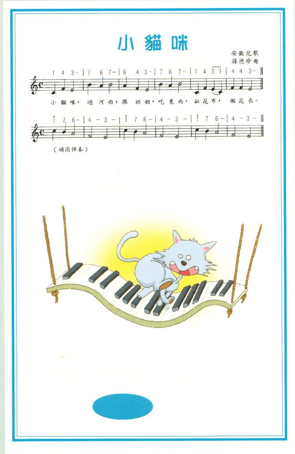
- 發給兩位幼兒各一片音磚,分別是 Mi 和 Si 音。告訴幼兒:當老師指揮到他時,要敲一下音磚。
- 唱到小貓「咪」時,指揮 Mi 音磚
- 唱到過河「西」時,指揮 Si 音磚
- 用 C’、B、A、F、E 五個音磚,配合音樂讓幼兒進行一次頑固伴奏,也可以讓幼兒自己嘗試伴奏。
English
- Give two children one resonator bar each — Mi and Si. Tell them: when the teacher points to you, strike your bar once.
- When singing “kitten Mi,” point to the Mi bar.
- When singing “crossing the bridge Si,” point to the Si bar.
- Use C’, B, A, F, E resonator bars to accompany the music, or let children try playing the accompaniment themselves.
- 6. 音樂特色解析 Musical Features
中文
- 採用日本式五聲音階(E, F, A, B, C’),省略 Re 和 Sol,呈現獨特的東方音色。
- 透過 Mi 和 Si 音的重複,引導幼兒感受旋律中的呼應與重點。
- 頑固伴奏: 從樂譜中可看出「都希拉法米,都希拉法米」的固定重複,成為整首歌的背景伴奏,提供穩定的節奏與音型,幫助孩子在律動與歌唱中建立穩定感。
- 藉故事情節與旋律結合,讓孩子在情境中體驗音階與情感變化。
English
- Uses the Japanese-style pentatonic scale (E, F, A, B, C’), omitting Re and Sol to create a distinctive Eastern color.
- Repetition of Mi and Si tones helps children sense melodic responses and focal points.
- Stubborn accompaniment: The score shows the repeating pattern “Do-Si-La-Fa-Mi, Do-Si-La-Fa-Mi,” which serves as the song’s background accompaniment, providing a stable rhythm and tone pattern that helps children feel grounded in both movement and singing.
- Combines story and melody, enabling children to experience both the scale and emotional changes within a narrative context.
 雅歌教育典藏站
發表留言