1. 單元目標 Unit Focus
中文
單元目標:樂句
教具:鋼琴
English
Focus: Musical phrases
Teaching Tool: Piano
2. 給老師和家長 For Teachers and Parents
中文
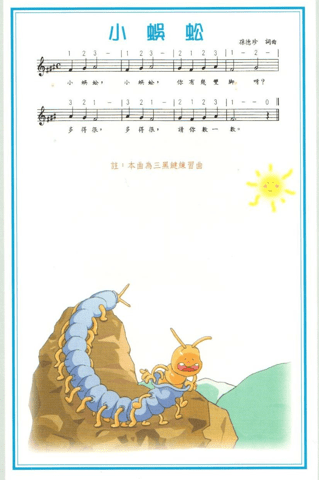
本單元歌曲是以鋼琴三黑鍵的音配合中文童謠寫成的三音旋律。藉著三個音的上下流動與所停的音不同,讓幼兒感覺兩樂句不同語氣(問句、答句)。
English
This unit uses a three-note melody on the black keys of the piano, paired with a traditional Chinese children’s rhyme. The upward and downward movement of the notes, along with the resting tones, helps children sense the contrasting moods of the two phrases — the question and the answer.
3. 故事 Story
中文
老師說故事:
從前有隻小蜈蚣,牠有好多雙腳。牠學會本領,可以往前走,也可以轉過身來往後走,覺得很得意。
新年到了,大家都穿新衣、穿新鞋,小蜈蚣也想買新鞋。牠試穿新鞋時,一隻隻腳輪流提起,把鞋穿上去,看了看覺得不滿意,再一隻隻腳輪流提起,把鞋脫下來。試了好幾款新鞋後,小蜈蚣終於找到自己喜歡的鞋子了。
English
Teacher’s Storytelling:
Once upon a time, there was a little centipede with many pairs of legs. It learned how to walk forward and also turn around to walk backward, which made it feel very proud.
When the New Year came, everyone wore new clothes and new shoes. The little centipede also wanted new shoes. It tried them on one by one — lifting each leg to put the shoes on — but wasn’t satisfied. It lifted each leg again to take them off. After trying many pairs, the centipede finally found the shoes it loved.
4. 歌曲 Song
中文
老師說:「小蜈蚣,小蜈蚣,你有幾雙腳呀?」(問)
小蜈蚣說:「多得很,多得很,請你數一數。」(答)
English (Note)
Lyrics are presented in Chinese to preserve cultural tone and rhythm. The melody mirrors the natural rise and fall of the Mandarin question-and-answer phrases.
5. 遊戲 Game: 小蜈蚣買鞋 Little Centipede Buys Shoes
中文
- 全班排成一長排,每個人手搭前面人的腰,請最前面和最後面的人當小蜈蚣的頭、尾。老師當鞋店的老闆。
- 一起唱本單元歌曲。唱完第一句「你有幾雙腳啊?」全體向後轉,轉身再走;唱完第二句「請你數一數」時,老師說:「我來數數看 1, 2, 3, 4, 5……」,全體跟著數到最後一位幼兒為止。
- 老師說:「沒那麼多,我只有三雙。」(比人數少)
- 報數超過的幼兒,就是沒有鞋子穿的,要立刻離開隊伍,再變成一隻小蜈蚣。
- 如果老師說:「我要一次賣六雙。」(比人數多)小蜈蚣的頭要再去拉人,湊足腳數。
English
- Children line up, holding the waist of the person in front to form a “centipede.” The first and last children are the head and tail; the teacher plays the shoe shop owner.
- Sing the song together. After the first phrase (“How many legs do you have?”), the centipede turns around and walks in the opposite direction. After the second phrase (“Please count them”), the teacher counts aloud (“1, 2, 3, 4, 5…”), and the children count along until the last child.
- The teacher may say, “I don’t have that many shoes — only three pairs!” (fewer than the children’s count).
- Any children beyond the counted number “don’t have shoes” and must leave the centipede to form a new one.
- If the teacher says, “I want to sell six pairs at once!” (more than the children’s count), the centipede’s head goes to invite more children to join and complete the number.
6. 音樂特色解析 Musical Features
中文
- 旋律緊貼中文聲調,讓孩子以語感唱準音高,體驗「說話就是唱歌」。
- 問句結尾落在屬和弦,如問號般製造懸念;答句結尾回到主和弦,如句號般帶來安定。
- 採三個黑鍵設計,幼兒用 2、3、4 指彈奏,拇指與小指自然落在白鍵,輕鬆建立鋼琴學習基礎。
English
- The melody follows the natural tones of Chinese speech, allowing children to sing in tune by ear — speaking becomes singing.
- The question phrase ends on the dominant chord (like a question mark), creating suspense; the answer phrase resolves to the tonic (like a period), bringing closure.
- The song uses three black keys, played with fingers 2, 3, and 4, while the thumb and little finger rest on white keys — a relaxed starting point for piano beginners.
 雅歌教育典藏站
發表留言