1. 單元目標 Unit Focus
中文
單元目標:重音
English
Focus: Accents (strong beats)
2. 給老師和家長 For Teachers and Parents
中文
本單元藉欣賞《動物狂歡節》中的「長耳人」抓樹藤的動作(不規律拍、重音),讓幼兒認識音樂中的重音。
English
This unit introduces accents in music through listening to “Characters with Long Ears” from Carnival of the Animals. The jumping and grabbing motions of the “long-eared figure” help children experience accented beats in an irregular rhythmic pattern.
3. 資料庫、律動、欣賞 Cultural Note, Movement, and Listening
中文
聆聽《動物狂歡節(長耳人)》,聽聽音樂中長耳人跳起來抓住樹藤(重音),跟著音樂學長耳人抓,抓的動作要快,不然就掉下去了。
English
Listen to Carnival of the Animals (Characters with Long Ears) and notice the accented notes where the long-eared figure jumps up to grab the vines. Children imitate this motion — the grab must be quick, or they “fall” if they miss the beat.
4. 故事 Story: 長耳人
中文
有個人他有一隻小狗,耳朵長長的,尾巴短短的,好可愛。
有一天,他遇到一位巫婆,巫婆說:「把你的這小狗給我,不然我就把你變成怪物。」
這個人不肯,於是巫婆就施了咒語,使他變成一隻長耳人。
太陽出來時,他就會變成長耳人,只要太陽下山,他就變回原來的樣子。
他的小狗看到他的怪樣子,認不出來就跑掉了。
長耳人好傷心,他到處找,可是森林好大,他怎麼找呢?
有了,他學猴子跳上樹,抬頭看看,有好多樹藤,用力一抓,盪過去,再用力抓另外一根到一邊去。
小狗躲起來,他聽到長耳人在找他,哦,越來越靠近了,怎麼辦,快躲好。
這邊長耳人找不到小狗,再到另一邊去,越跳越遠了。
English
Once there was a man who had a little dog with long ears and a short tail — very cute indeed.
One day, he met a witch who said, “Give me your little dog, or I will turn you into a monster!”
The man refused, so the witch cast a spell and turned him into a long-eared creature.
When the sun rose, he became the long-eared creature; when the sun set, he turned back into himself.
But his little dog didn’t recognize him in this strange form and ran away.
The long-eared creature was heartbroken. He searched everywhere, but the forest was huge — how could he find his dog?
Then he got an idea: he climbed trees like a monkey, looked up, saw many vines, grabbed one, swung across, and grabbed another to keep going.
Meanwhile, the little dog was hiding. The creature heard the dog nearby — closer and closer! What to do? Quickly hide!
When he couldn’t find the dog in one place, he leapt to another, farther and farther away.
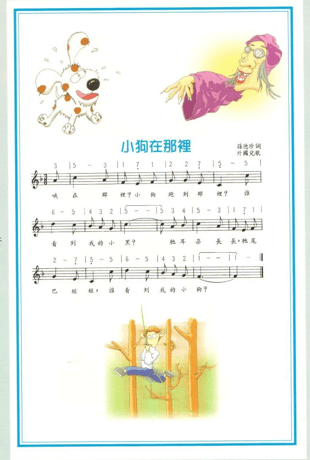
5. 遊戲 Game: 小狗在那裡 Little Dog, Where Are You?
中文
- 全體圍成一個圓圈,請一位幼兒到圈外當長耳人。
- 指定一位幼兒當小狗,不要讓長耳人知道。遊戲開始時大家一起唱「小狗在那裡」,小狗帶大家做動作。長耳人進入圈中尋找,如果他走近「小狗」,大家要越唱越大聲;長耳人走遠,則越唱越小聲。
- 猜中誰是小狗,長耳人就可以回來,換小狗出去當長耳人,圓圈裡的幼兒再選一人當小狗,以此類推。
English
- Children form a circle. One child stands outside the circle as the “long-eared creature.”
- Secretly assign one child inside the circle to be the “little dog.” At the start, everyone sings Little Dog, Where Are You? The “dog” leads the group’s movements. As the long-eared creature searches, the singing gets louder when closer to the dog, and softer when farther away.
- When the creature correctly identifies the dog, they switch roles: the dog becomes the seeker, and another child is chosen to be the new dog.
6. 音樂特色解析 Musical Features
中文
- 以重音表現動作的突然發力,如長耳人抓樹藤時的跳躍與用力。
- 透過強弱對比和不規律的拍點,營造尋找與驚險的戲劇氛圍。
- 結合聆聽、動作與故事,引導幼兒在遊戲中感受重音與節奏變化。
English
- Accented notes depict sudden bursts of energy, such as the long-eared figure leaping and grabbing vines.
- Strong-weak contrasts and irregular rhythms create a playful yet suspenseful atmosphere.
- Combining listening, movement, and storytelling allows children to experience accents and rhythmic shifts through interactive play.
 雅歌教育典藏站
發表留言